
Kilometer to Mile Converter (km to miles Calculator)
Kilometer to Mile Converter (Reversible Calculator)
Conversion Result
How to Use our Kilometer to Mile Calculator
Follow these simple steps to convert distances instantly.
Step 1: Locate the Input Fields
- You will see two boxes side-by-side (or stacked).
- The first is labeled “Kilometer (km)” and the second is labeled “Mile (mi)” .
Step 2: Enter a Value in Kilometers
- Click inside the box labeled “Kilometer.”
- Type any number (for example, 10). You can use decimals too (like 5.5).
Step 3: Watch the Magic Happen (Real-Time)
- As soon as you start typing, the “Mile” box will automatically update with the converted value.
- Example: If you type 10 km, the Mile box will instantly show 6.21 mi.
Step 4: Or, Do It Backwards (Miles to Kilometers)
- You can also click inside the “Mile” box and type a number.
- The “Kilometer” box will automatically update to show the conversion in reverse.
Step 5: Check the Step-by-Step Math
- Look below the input boxes at the “Calculation Steps” section.
- The calculator will show you exactly how it got the answer:
- It will show the formula used (Kilometers ÷ 1.60934).
- It will show the math plugged in (e.g., 10 ÷ 1.60934).
- It will show the final result.
Step 6: Clear the Fields
If you want to start over, simply delete the number from either box. Both boxes will clear automatically.
What is a Kilometer?
A kilometer (km) is a unit used to measure long distances, like how far your school is from home or the length of a running track or how is one city from another. It’s part of the metric system, which is used worldwide (except in a few countries like the USA). In USA miles is the most common terms used to measure distances. One kilometer is a little more than half a mile (about 0.62 miles).What is a Mile?
A mile is a way to measure distance, mostly used in the United States and a few other countries. It’s longer than a kilometer. If you think about walking, one mile is about how far you’d walk in 15 to 20 minutes at a normal pace. People often use miles to describe how far it is to drive somewhere, from point A to point B.
A mile is equal to about 1.61 kilometers or 1,609 meters. So, it is just another way to describe how far something is, just like kilometers but a little bigger!
Convert Kilometers to Miles Instantly
If you’ve ever needed to go from km to miles, you know it can be a little annoying to do the math in your head. Honestly, I still get mixed up sometimes. The easiest way to convert km to miles is just to multiply by 0.621371 so for example, 10 km turns into about 6.21 miles. But let’s be real, nobody wants to do that every single time.
Our kilometer to mile converter is designed for convenience and accuracy. Just enter the distance in kilometers, and the equivalent value in miles will be displayed immediately. This is especially useful for runners tracking distances like 5K or 10K races, travelers comparing road distances, or students solving conversion problems.
I’ve used these converters for everything from race tracking to travel planning, and they work great for small or large numbers. So yeah, skip the formula if you want and just plug in the kilometers and let our calculator do its thing.
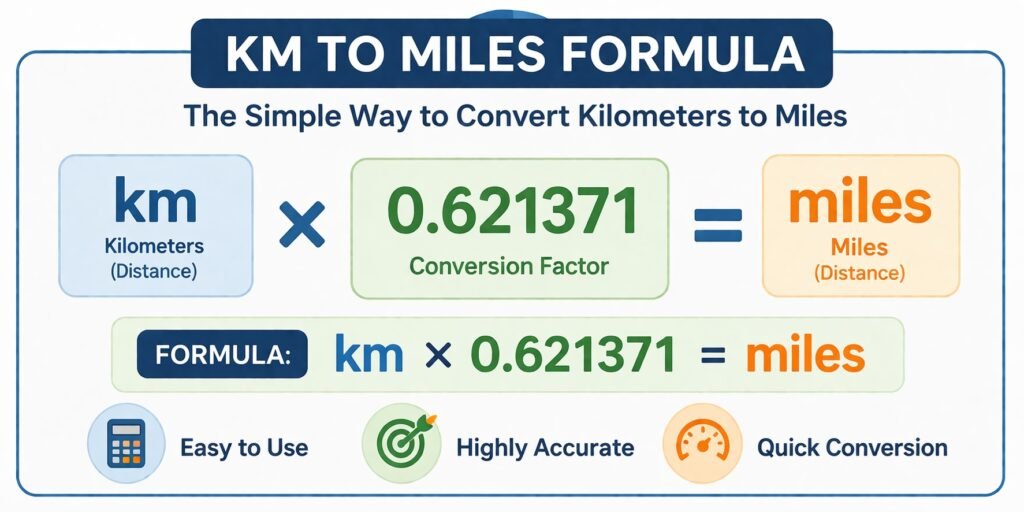
Kilometer to Mile Formula
Miles = Kilometers × 0.621371
That’s it. So if you’ve got 5 kilometers, just multiply: 5 × 0.621371 = about 3.11 miles.
Some people find it easier to remember a slightly rougher version, multiply by 0.62. But the full number is more accurate and if you ever want to go the other way (miles back to kilometers), you’d divide by the same number or multiply by 1.609.
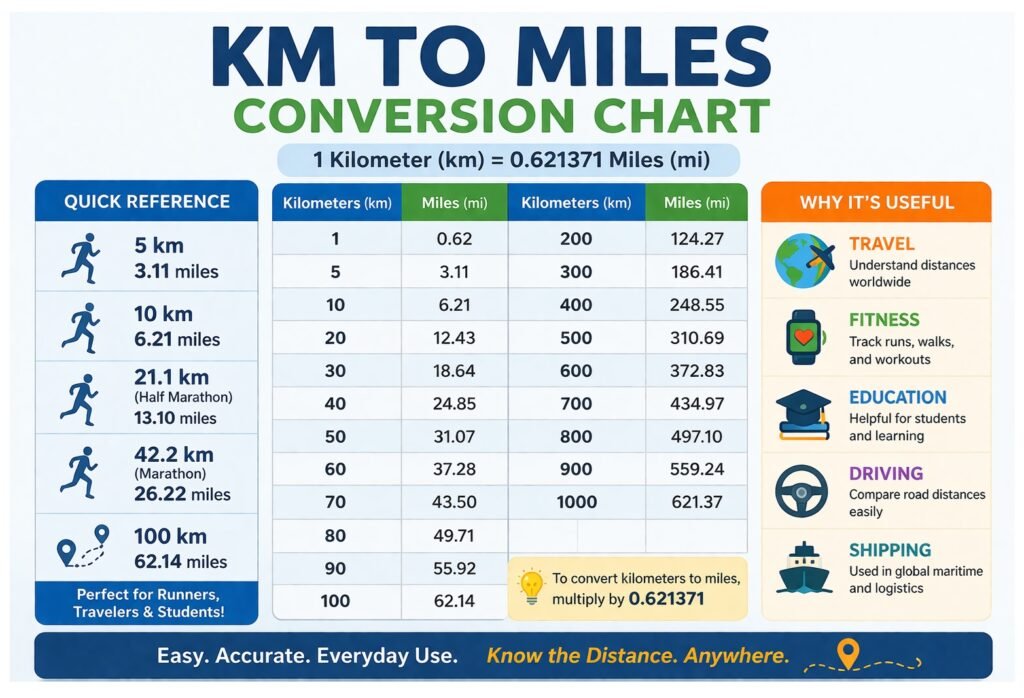
Km to Miles Conversion Chart (Complete Table)
| Kilometers (km) | Miles (mi) |
| 1 km | 0.62 miles |
| 2 km | 1.24 miles |
| 3 km | 1.86 miles |
| 4 km | 2.49 miles |
| 5 km | 3.11 miles |
| 6 km | 3.73 miles |
| 7 km | 4.35 miles |
| 8 km | 4.97 miles |
| 9 km | 5.59 miles |
| 10 km | 6.21 miles |
| 11 km | 6.84 miles |
| 12 km | 7.46 miles |
| 13 km | 8.08 miles |
| 14 km | 8.70 miles |
| 15 km | 9.32 miles |
| 20 km | 12.43 miles |
| 21 km (Half Marathon) | 13.05 miles |
| 25 km | 15.53 miles |
| 30 km | 18.64 miles |
| 35 km | 21.75 miles |
| 40 km | 24.85 miles |
| 42 km (Marathon) | 26.10 miles |
| 45 km | 27.96 miles |
| 50 km | 31.07 miles |
| 60 km | 37.28 miles |
| 70 km | 43.50 miles |
| 80 km | 49.71 miles |
| 90 km | 55.92 miles |
| 100 km | 62.14 miles |
| 200 km | 124.27 miles |
| 300 km | 186.41 miles |
| 400 km | 248.55 miles |
| 500 km | 310.69 miles |
| 1000 km | 621.37 miles |
How to Convert Kilometers to Miles Manually
Converting kilometers to miles by hand is simple once you know the basic rule. You just multiply the number of kilometers by 0.621371 to get the answer in miles. For example, if you want to convert 8 km, you multiply 8 × 0.621371, which gives about 4.97 miles. If you don’t want to use a calculator, you can also use a quick trick which is just multiply by 0.62 for an approximate answer. This works well for everyday use when you just need a close value. Learning this method is helpful in exams, travel, or situations where you don’t have internet access.
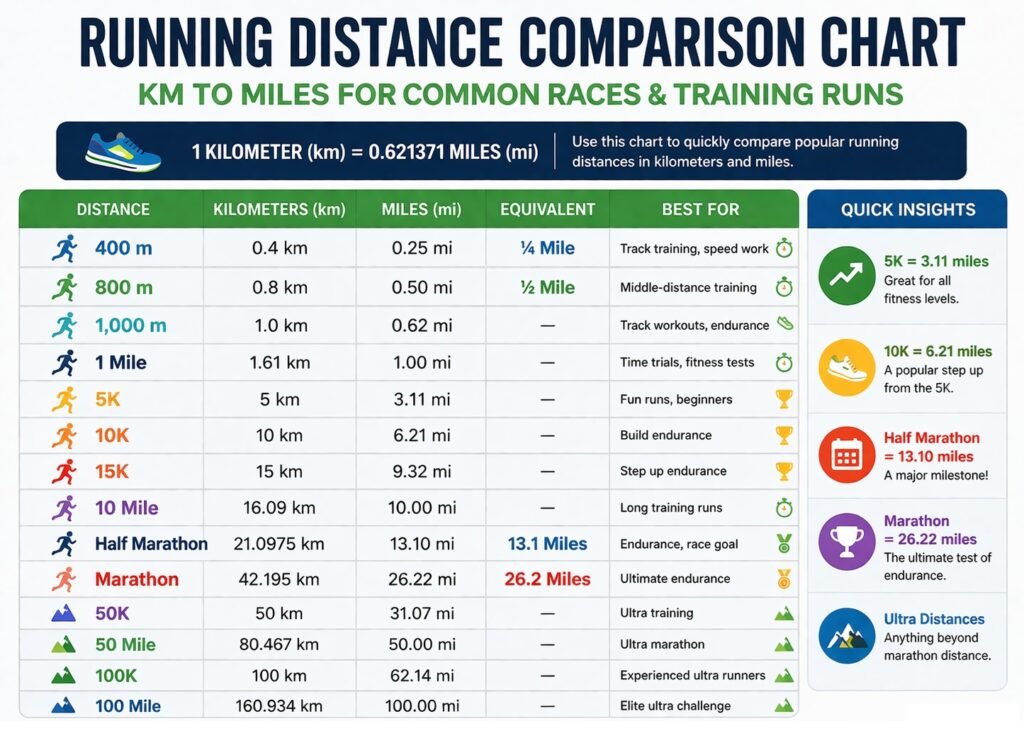
Km to Miles for Running & Walking Distances
Many runners and walkers see distances in kilometers, especially in races and fitness apps, but prefer to understand them in miles. For example, a 5 km run is a little over 3 miles, which is a common beginner goal. A 10 km distance is just over 6 miles and is popular for fitness challenges. Walking distances like 2 km or 3 km are also easier to understand when converted to miles. Knowing these conversions helps you track your progress better and set realistic goals. It also makes it easier to compare distances if you are used to miles instead of kilometers.
Which is longer, a mile or a kilometer?
A mile is longer than a kilometer. If you walk one kilometer and then walk one mile, you’ll notice the mile takes more time. In fact, one mile is about 1.61 kilometers.
Why are miles and kilometers different?
Miles and kilometers are different because they come from two different measurement systems. Miles are used in countries like the United States, while kilometers are used in most other countries including Asia and UK/Europe.
Real-Life Use Cases of Km to Miles Conversion
Running distances
Many runners use kilometers in races, but think in miles when tracking progress. For example, a 7 km run is over 4 miles and infact close to 7.5 miles, which helps beginners understand their distance better. Converting km to miles makes it easier to set goals, compare runs, and follow training plans.
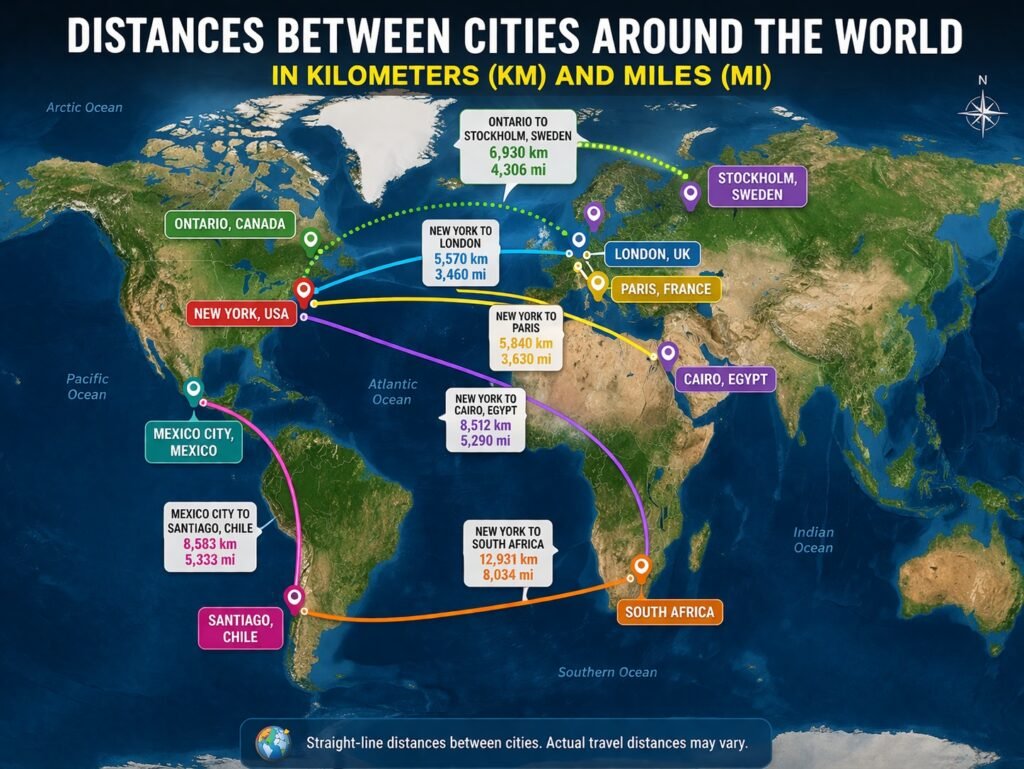
Travel distance conversion
When traveling between countries especially from European or Asian countries to US, distances may be shown in kilometers instead of miles. Converting km to miles helps drivers and tourists better understand how far they need to go. This is especially useful for road trips and navigation.
Fitness tracking
Fitness apps often show distance in kilometers, but some users prefer miles. Converting km to miles helps you track steps, workouts, and daily activity more clearly. It also helps you stay consistent with your fitness goals.
Aviation industry
In aviation, distances are often measured in kilometers or nautical miles. Converting kilometers to miles can help travelers better understand flight distances and travel time.
Automotive Industry
Car speed and distance in many countries are shown in kilometers. Converting km to miles helps drivers understand mileage, fuel efficiency, and travel distance more easily.
Sports and athletics
Different sports use different units. Track events may use meters and kilometers, while others use miles. Converting km to miles helps athletes compare performance across different events.
Education
Students often learn both metric and imperial systems. Knowing how to convert kilometers to miles helps in math problems, exams, and real-life applications.
Maritime & Shipping
Shipping routes may use kilometers or nautical miles. Converting to miles helps in better understanding shipping distances and travel routes.
Frequently Asked Questions (Km to Miles Conversion)
What is 5 km in miles?
5 kilometers is equal to approximately 3.11 miles. This is a common running distance.
What is 10 km in miles?
10 kilometers is equal to about 6.21 miles. It is a popular race distance.
Why is km to miles conversion important?
It helps people understand distances when traveling, running, or studying between metric and imperial systems.
How do you convert kilometers to miles?
Multiply the number of kilometers by 0.621371 to get miles.
How many miles is 1 kilometer?
1 kilometer is approximately 0.62 miles.
Is 5 km equal to 3 miles?
5 km is slightly more than 3 miles. The exact value is about 3.11 miles.
What is 21 km in miles?
21 kilometers is about 13.05 miles, known as a half marathon distance.
What is 42 km in miles?
42 kilometers is approximately 26.2 miles, the standard marathon distance.
Can I convert km to miles without a calculator?
Yes, multiply kilometers by 0.62 for a quick estimate.
Which countries use kilometers and miles?
Most countries use kilometers, while the United States uses miles.
What is the fastest way to convert km to miles?
Using an online calculator is the fastest and most accurate method.
How accurate is km to miles conversion?
It is very accurate when using the correct conversion factor of 0.621371.
Other Calculators
Grams to Teaspoon, Fl oz to cups, oz to ml, Simple Interest Calculator, Compound Interest Calculator