
USD vs INR Future Projection Calculator with Historical Exchange Rate Chart (2000–2050)
Table of Contents
USD vs INR Average Annual Increase
📈 USD to INR Future Projection Calculator (2000–2050)
Enter a value (e.g., 1.8) = all future projections based on fixed % per year.
(2000 → Today)
as of Dec 31, 2050
📉 Projected Exchange Rate Graph (2026 – 2050)
📅 Future Projection Table (Dec 31 each year)
| Year (Dec 31) | Projected USD → INR |
|---|---|
| Loading... | |
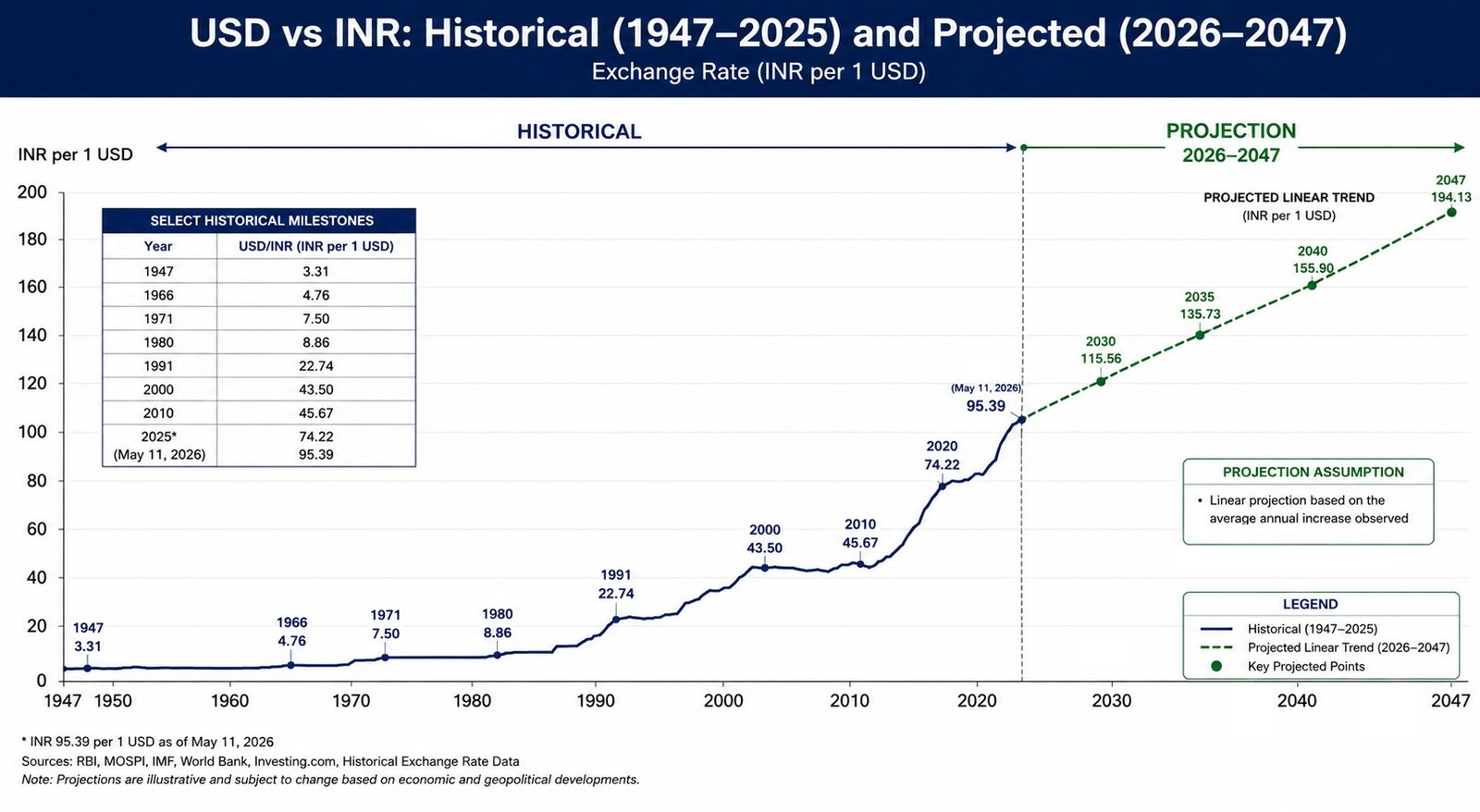
USD vs INR Historical Exchange Rate Table (1947–2025)
Base: Approximate historical end-of-year USD to INR exchange rate values (₹ per $1 USD).
Note: Early historical exchange rates before liberalization were government-controlled/pegged and exact Dec 31 closing values may vary slightly across historical archives. These figures are compiled from publicly available historical exchange rate references and financial archives.
The USD vs INR Historical Exchange Rate Table shows the complete historical USD INR journey from 1947 to 2025. It helps explain the rupee history, major currency changes, and how economic events affected the Indian Rupee over time. This INR depreciation history highlights important periods like the 1966 devaluation, 1991 economic crisis, and recent currency fluctuations. The table is useful for students, researchers, investors, and anyone interested in understanding long-term USD to INR exchange rate trends.
| Date | USD/INR |
| Aug 15, 1947 | 3.3 |
| Dec 31, 1948 | 3.31 |
| Dec 31, 1949 | 4.76 |
| Dec 31, 1950 | 4.76 |
| Dec 31, 1951 | 4.76 |
| Dec 31, 1952 | 4.76 |
| Dec 31, 1953 | 4.76 |
| Dec 31, 1954 | 4.76 |
| Dec 31, 1955 | 4.76 |
| Dec 31, 1956 | 4.76 |
| Dec 31, 1957 | 4.76 |
| Dec 31, 1958 | 4.76 |
| Dec 31, 1959 | 4.76 |
| Dec 31, 1960 | 4.76 |
| Dec 31, 1961 | 4.76 |
| Dec 31, 1962 | 4.76 |
| Dec 31, 1963 | 4.76 |
| Dec 31, 1964 | 4.76 |
| Dec 31, 1965 | 4.76 |
| Dec 31, 1966 | 7.5 |
| Dec 31, 1967 | 7.5 |
| Dec 31, 1968 | 7.5 |
| Dec 31, 1969 | 7.5 |
| Dec 31, 1970 | 7.5 |
| Dec 31, 1971 | 7.49 |
| Dec 31, 1972 | 7.59 |
| Dec 31, 1973 | 7.74 |
| Dec 31, 1974 | 8.1 |
| Dec 31, 1975 | 8.39 |
| Dec 31, 1976 | 8.97 |
| Dec 31, 1977 | 8.74 |
| Dec 31, 1978 | 8.2 |
| Dec 31, 1979 | 8.13 |
| Dec 31, 1980 | 7.86 |
| Dec 31, 1981 | 8.66 |
| Dec 31, 1982 | 9.46 |
| Dec 31, 1983 | 10.1 |
| Dec 31, 1984 | 11.36 |
| Dec 31, 1985 | 12.37 |
| Dec 31, 1986 | 12.61 |
| Dec 31, 1987 | 12.96 |
| Dec 31, 1988 | 13.92 |
| Dec 31, 1989 | 16.23 |
| Dec 31, 1990 | 17.5 |
| Dec 31, 1991 | 22.74 |
| Dec 31, 1992 | 26.01 |
| Dec 31, 1993 | 31.37 |
| Dec 31, 1994 | 31.37 |
| Dec 31, 1995 | 32.43 |
| Dec 31, 1996 | 35.43 |
| Dec 31, 1997 | 36.31 |
| Dec 31, 1998 | 41.26 |
| Dec 31, 1999 | 43.06 |
| Dec 31, 2000 | 45.68 |
| Dec 31, 2001 | 47.19 |
| Dec 31, 2002 | 48.61 |
| Dec 31, 2003 | 45.32 |
| Dec 31, 2004 | 43.5 |
| Dec 31, 2005 | 44.1 |
| Dec 31, 2006 | 45.31 |
| Dec 31, 2007 | 39.42 |
| Dec 31, 2008 | 48.82 |
| Dec 31, 2009 | 46.37 |
| Dec 31, 2010 | 44.7 |
| Dec 31, 2011 | 53.06 |
| Dec 31, 2012 | 54.99 |
| Dec 31, 2013 | 61.8 |
| Dec 31, 2014 | 63.33 |
| Dec 31, 2015 | 66.15 |
| Dec 31, 2016 | 67.92 |
| Dec 31, 2017 | 63.87 |
| Dec 31, 2018 | 69.79 |
| Dec 31, 2019 | 71.36 |
| Dec 31, 2020 | 73.07 |
| Dec 31, 2021 | 74.34 |
| Dec 31, 2022 | 82.73 |
| Dec 31, 2023 | 83.21 |
| Dec 31, 2024 | 83.38 |
| Dec 31, 2025 | 85.56 |
Key Historical Milestones
- 1947–1965: INR was largely pegged to the British Pound under a controlled exchange regime.
- 1966: Major rupee devaluation moved USD/INR from ~4.76 to ~7.50.
- 1991 Economic Crisis: Sharp depreciation during India’s balance-of-payments crisis.
- 1993: India adopted a market-determined exchange rate system.
- 2008 Financial Crisis: Rupee weakened significantly during the global recession.
- 2022 onward: USD strength, inflation, oil imports, and global uncertainty pushed USD/INR above ₹80.
USD to INR Forecast for 2030
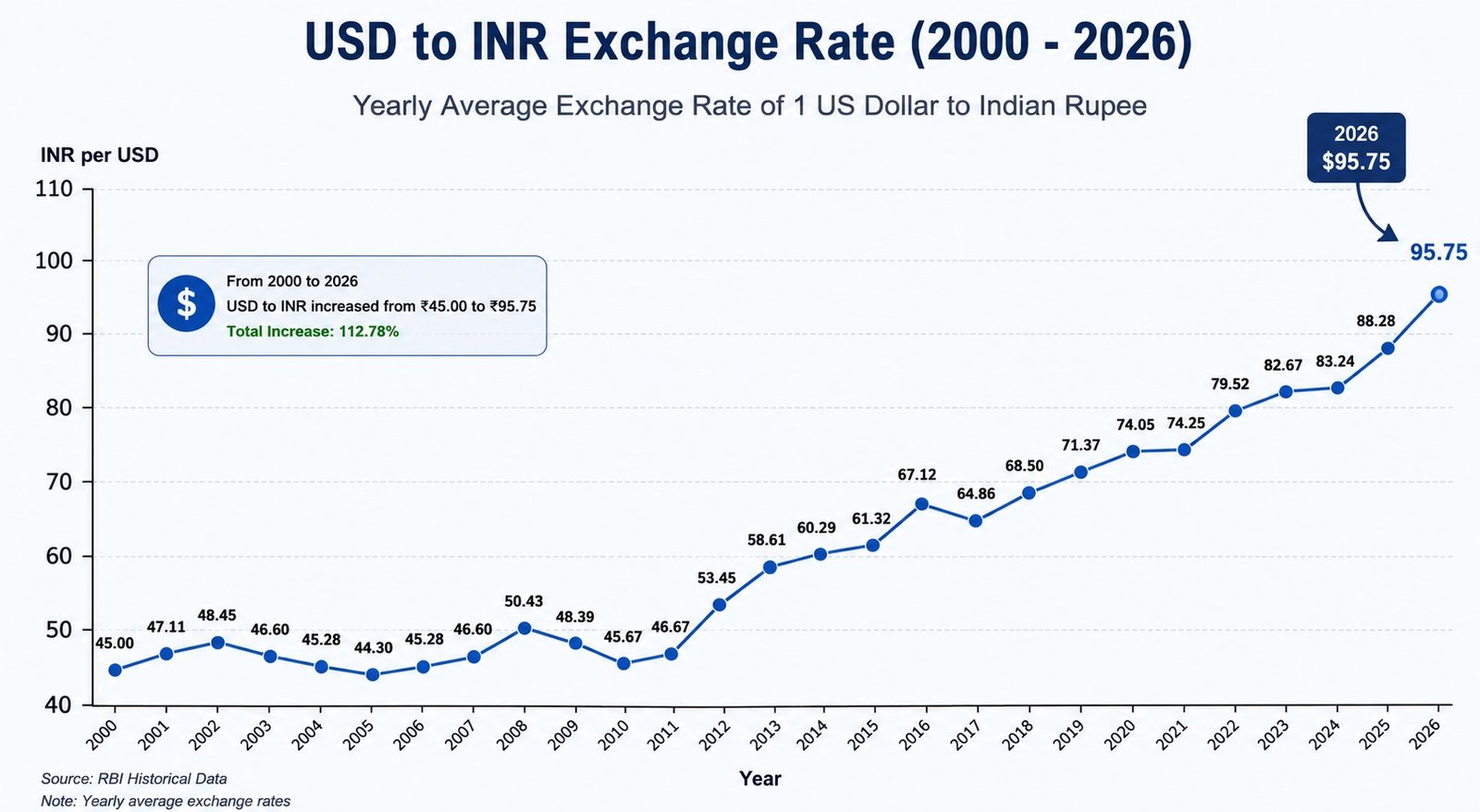
Based on long-term historical trends, the USD to INR forecast for 2030 suggests the US Dollar may trade around ₹105 to ₹110. Since India’s independence in 1947, USD vs INR has shown an average annual increase of nearly 4.4%, while from 2000 to 2026 the average increase remained around 3%. Factors like inflation, crude oil imports, RBI policy, US interest rates, and India’s economic growth will strongly influence the rupee forecast. Many forex analysts expect gradual INR depreciation rather than sudden crashes.
USD to INR Forecast for 2035
The USD to INR forecast for 2035 indicates the dollar could reach approximately ₹125 to ₹130 if historical currency depreciation trends continue. India’s rising imports, global trade imbalance, inflation differences, and strong US Dollar demand may continue pressuring the Indian Rupee. Historical data shows that the rupee has steadily weakened over decades against the USD. However, strong GDP growth, digital economy expansion, exports, and foreign investments could slow the pace of rupee depreciation in coming years.
USD to INR Forecast for 2040
The USD to INR forecast for 2040 may place the exchange rate near ₹140 to ₹150 per US Dollar under long-term average growth assumptions. If the rupee continues weakening at 3% to 4% annually, similar to historical trends from 1947 to 2025 and during recent decades, INR depreciation may continue gradually. Currency markets are affected by inflation, fiscal deficit, geopolitical tensions, oil prices, RBI intervention, and global recession risks. India becoming a larger global economy could help stabilize the rupee over the long term.
USD to INR Forecast for 2045
The USD to INR forecast for 2045 suggests the exchange rate could move toward ₹160 to ₹180 per USD if current long-term currency trends continue. Over the last several decades, the Indian Rupee has consistently depreciated against the US Dollar because of inflation differences and global demand for USD as the world reserve currency. Experts believe India’s economic growth, manufacturing expansion, digital payments ecosystem, and export growth could reduce extreme currency weakness, but moderate rupee depreciation may still remain a long-term trend.
USD to INR Forecast for 2050
The USD to INR forecast for 2050 estimates the US Dollar may trade between ₹190 and ₹220 based on historical average annual depreciation rates of last 75 to 80 years. If USD vs INR continues rising near its long-term average trend of 3.2% yearly growth, the rupee could weaken steadily over the next 25 years. Important factors affecting the future USD to INR rate include India’s GDP growth, foreign reserves, inflation control, RBI monetary policy, global recession risks, oil imports, and strength of the US economy. Long-term forex forecasts always remain estimates and can change with economic conditions.
Average Annual INR Depreciation Rate
Since Independence 1947
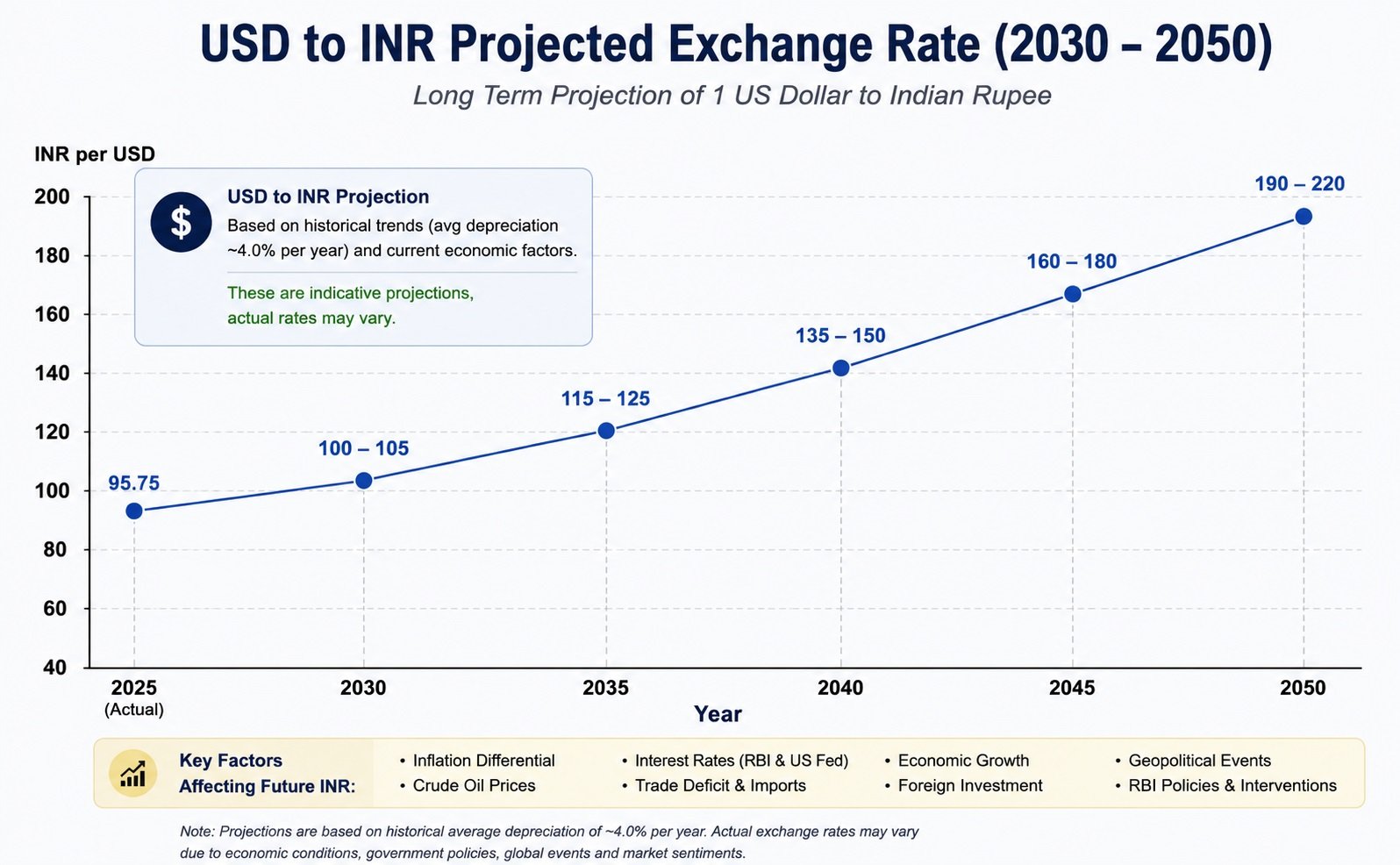
The average annual INR depreciation rate since India’s independence on Aug 15, 1947 has remained close to 4%–4.5% against the US Dollar. In 1947, 1 USD was around ₹3.30, while by 2025 it crossed ₹85. The Indian Rupee weakened gradually because of inflation, oil imports, trade deficits, wars, and rising demand for the US Dollar. During the 1966 government-led devaluation under Indira Gandhi, the rupee sharply fell from ₹4.76 to ₹7.50 per USD. Economic reforms in 1991 under P. V. Narasimha Rao and Finance Minister Manmohan Singh helped stabilize India’s economy after a major financial crisis.
During Economic Reforms
From 1991 onward, the average annual INR depreciation rate stayed around 3%–4% as India moved toward a liberalized economy and market-based exchange rates. The 1991 balance-of-payments crisis forced India to open markets, attract foreign investment, and reduce import restrictions. Governments led by Atal Bihari Vajpayee focused heavily on infrastructure, highways, telecom growth, and economic expansion, which helped improve investor confidence. However, global oil price shocks, fiscal deficits, and dependence on imports continued weakening the rupee slowly over time. The rise of IT exports and outsourcing also helped India earn more foreign exchange and partially balance INR depreciation. Source: Forbes India.
Since Year 2000
Between Jan 1, 2000 and 2026, USD vs INR increased at an average annual rate of nearly 3%. During this period, India saw strong GDP growth, expansion of the middle class, growth in digital technology, and rising foreign investment. Under the governments of Manmohan Singh and later Narendra Modi, India improved infrastructure, digital payments, manufacturing, highways, and startup growth. However, demonetization, COVID-19 disruptions, inflation, unemployment concerns, and rising crude oil prices also created pressure on the Indian Rupee. Strong US interest rates and global uncertainty further increased demand for the US Dollar worldwide. Source: Indiatimes
Under BJP Government, Since 2014
Since May 26, 2014, the USD to INR exchange rate has increased at roughly 4.1% annually. During this period, the government led by Narendra Modi introduced initiatives like Digital India, GST, UPI payments, highway expansion, manufacturing incentives, and startup support. India also became one of the world’s fastest-growing major economies. On the other hand, critics point to rising fuel prices, unemployment, inflation, currency weakness, and economic stress after demonetization and the pandemic. Global events like the Russia-Ukraine war, rising US Federal Reserve interest rates, and high oil imports also played a major role in weakening the rupee against the dollar.
Will USD Reach ₹100?
Yes, many long-term forex analysts believe USD to INR reaching ₹100 is highly possible within the next few years if historical trends continue. Since India’s independence in 1947, the Indian Rupee has depreciated steadily against the US Dollar at an average annual rate of nearly 4%–4.5%. Based on recent trends from 2000 to 2026, where USD vs INR increased around 3% yearly, the ₹100 level could potentially be reached around 2026–2027.
Rising oil imports, inflation, fiscal deficits, global uncertainty, and strong US Dollar demand are major reasons behind long-term INR depreciation. At the same time, India’s economic growth, exports, foreign investment, and RBI intervention could slow down the pace.
Will USD Reach ₹150?
The possibility of USD reaching ₹150 cannot be ruled out over the long term. If the rupee continues weakening at historical average rates, many long-term projections suggest USD/INR could approach ₹150 sometime around the late 2030s or early 2040s. India remains heavily dependent on crude oil imports, and global events like recessions, wars, inflation, and rising US interest rates usually strengthen the dollar further. Governments led by leaders like P. V. Narasimha Rao, Atal Bihari Vajpayee, Manmohan Singh, and Narendra Modi introduced economic reforms, infrastructure growth, digital payments, manufacturing incentives, and export expansion which helped stabilize the economy. However, inflation and currency depreciation still remained long-term trends.
Will USD Reach ₹200?
USD reaching ₹200 against INR is possible in the very long term if current depreciation trends continue for several more decades. Using historical average annual INR depreciation of 4%–4.5% since 1947, some projections indicate USD/INR could move near ₹200 around 2048–2055.
However, currency forecasting over such long periods is extremely uncertain because future exchange rates depend on many factors including India’s GDP growth, foreign reserves, inflation control, trade balance, RBI policies, global economic conditions, and geopolitical stability. If India becomes a stronger manufacturing and export-driven economy with lower inflation and higher foreign investment, the rupee could stabilize much better than past decades.
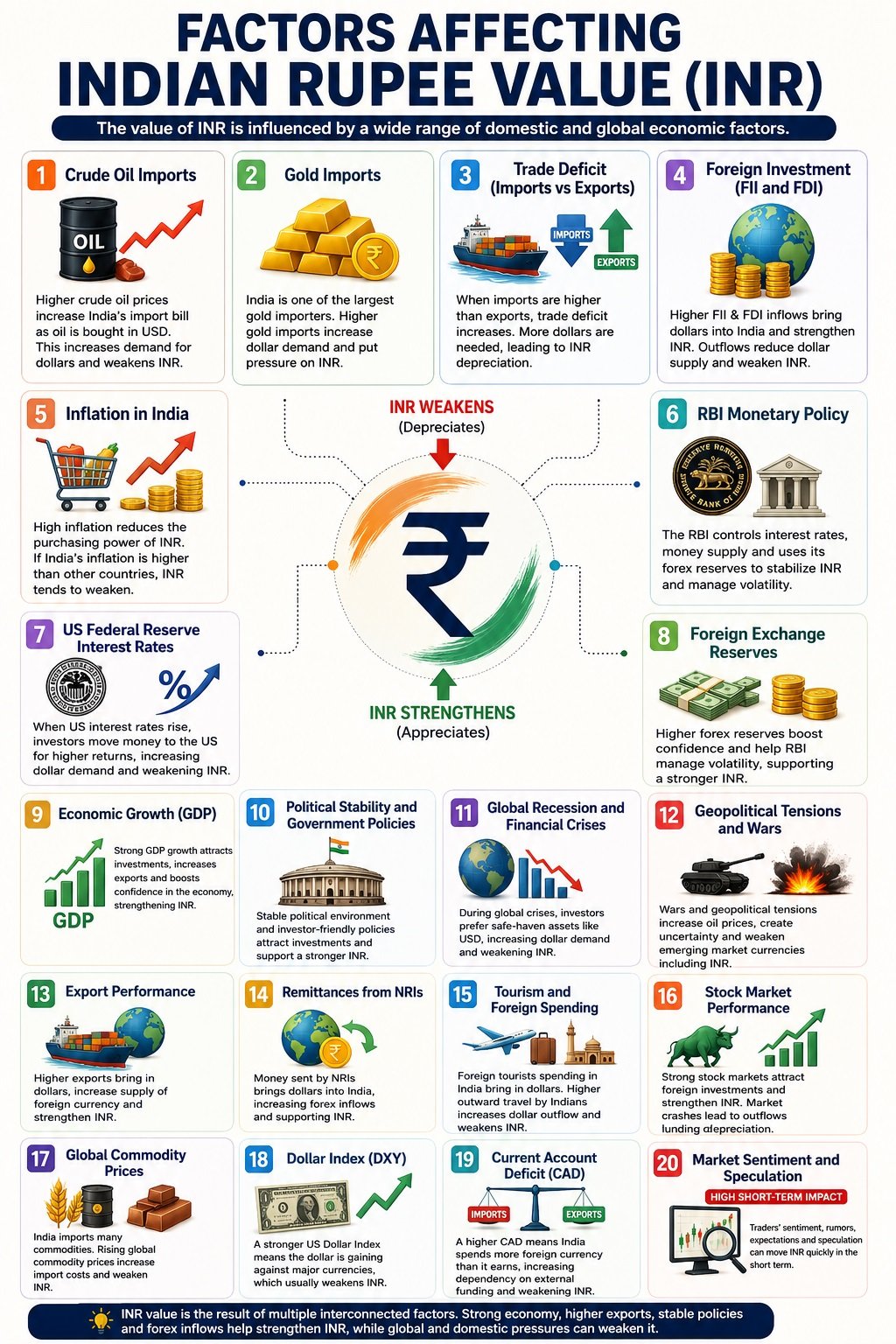
Factors Affecting Indian Rupee Value (INR)
The value of the Indian Rupee (INR) against the US Dollar and other global currencies changes daily because of many domestic and international economic factors. India is a large developing economy and also a major importer of oil, gold, electronics, and industrial goods, so global events strongly affect USD vs INR exchange rates.
1. Crude Oil Imports
India imports nearly 80%–85% of its crude oil needs from foreign countries. Oil purchases are mostly made in US Dollars. When crude oil prices rise globally, India needs more dollars to pay for imports, increasing demand for USD and weakening the Indian Rupee. Higher fuel prices also increase inflation and trade deficit.
2. Gold Imports
India is one of the world’s largest gold importers. During festivals, weddings, and uncertain economic conditions, gold imports rise sharply. Since gold is bought internationally in US Dollars, heavy gold imports increase dollar demand and put pressure on INR depreciation.
3. Trade Deficit (Imports vs Exports)
When India imports more products than it exports, it creates a trade deficit. India imports crude oil, electronics, semiconductors, machinery, chemicals, and defense equipment in large quantities. If exports like software services, pharmaceuticals, textiles, automobiles, and agricultural products do not grow equally, the rupee weakens over time.
4. Foreign Investment (FII and FDI)
Foreign Institutional Investors (FIIs) and Foreign Direct Investment (FDI) strongly affect INR value. When global investors invest money in Indian stock markets, startups, factories, and infrastructure, dollars flow into India and strengthen the rupee. But when investors pull money out during global uncertainty or recession fears, INR weakens quickly.
5. Inflation in India
Higher inflation reduces the purchasing power of the Indian Rupee. If inflation in India stays higher than inflation in the United States for long periods, INR usually depreciates against USD. Rising food prices, fuel costs, housing, and transportation expenses all impact inflation.
6. RBI Monetary Policy
The Reserve Bank of India controls interest rates, money supply, and forex reserves. RBI sometimes sells US Dollars from reserves to stabilize the rupee during sharp depreciation. Interest rate changes by RBI also affect foreign investments and currency strength.
7. US Federal Reserve Interest Rates
The US Federal Reserve plays a major role in global currency markets. When US interest rates increase, investors move money from emerging markets like India into safer US assets. This strengthens the US Dollar and weakens the Indian Rupee.
8. Foreign Exchange Reserves
India’s foreign exchange reserves help support INR stability. Large reserves allow RBI to manage sudden currency volatility. Higher reserves generally improve investor confidence and reduce panic during economic crises.
9. Economic Growth (GDP)
Strong GDP growth usually supports the rupee because it attracts investments and improves business confidence. India’s growth in IT services, manufacturing, digital economy, infrastructure, and exports has helped reduce extreme currency weakness over time.
10. Political Stability and Government Policies
Stable governments and clear economic policies improve investor confidence. Reforms like GST, digital payments, highway construction, manufacturing incentives, and startup support attract foreign investment. Political instability, corruption concerns, or policy uncertainty can negatively impact INR.
11. Global Recession and Financial Crises
During global crises, investors usually buy US Dollars because USD is considered a safe-haven currency. Events like the 2008 financial crisis, COVID-19 pandemic, banking crises, and geopolitical wars increased dollar demand and weakened INR.
12. Geopolitical Tensions and Wars
Wars and global conflicts increase oil prices and create uncertainty in financial markets. Events like the Russia-Ukraine war, Middle East tensions, and China-Taiwan concerns impact the Indian Rupee through higher import bills and global market volatility.
13. Export Performance
India earns foreign currency through exports of:
- IT services
- Pharmaceuticals
- Automobiles
- Petroleum products
- Textiles
- Chemicals
- Agricultural products
Strong export growth increases dollar inflows and supports INR stability.
14. Remittances from NRIs
India receives one of the world’s largest remittance inflows from Non-Resident Indians (NRIs). Money sent from countries like the United States, UAE, Canada, UK, and Australia increases foreign currency inflow and helps support the rupee.
15. Tourism and Foreign Spending
Foreign tourists spending money in India bring foreign currency into the country. Similarly, when Indians travel abroad heavily, more dollars are spent outside India, increasing pressure on INR.
16. Stock Market Performance
Strong Indian stock markets attract foreign investors and strengthen the rupee. Market crashes or uncertainty often lead to foreign investor selling and rupee depreciation.
17. Global Commodity Prices
Prices of commodities like crude oil, natural gas, fertilizers, edible oils, metals, and coal directly impact India because India imports many raw materials. Rising commodity prices usually weaken INR.
18. Dollar Index (DXY)
The US Dollar Index measures dollar strength globally. When the dollar strengthens worldwide, emerging market currencies including INR usually weaken.
19. Current Account Deficit (CAD)
A high Current Account Deficit means India is spending more foreign currency than it earns. Persistent CAD increases dependence on foreign capital and weakens INR over time.
20. Market Sentiment and Speculation (High Short-Term Impact)
Forex traders, hedge funds, and large banks trade currencies daily. News, rumors, elections, interest rate expectations, and economic data can quickly move USD vs INR exchange rates even without major economic changes.
Frequently Asked Questions (FAQs)
What will USD to INR be in 2030?
Based on historical USD vs INR trends and average annual INR depreciation rates, many long-term forecasts estimate USD to INR could trade between ₹98 and ₹105 by 2030. Actual exchange rates will depend on inflation, crude oil prices, RBI policies, US interest rates, and India's economic growth.
Will USD reach ₹100?
Yes, many forex analysts believe USD reaching ₹100 is possible within the next few years if long-term INR depreciation trends continue. Rising imports, inflation, global uncertainty, and strong US Dollar demand are major reasons behind this expectation.
Why does INR weaken against USD?
The Indian Rupee weakens against the US Dollar mainly because of inflation, crude oil imports, trade deficits, rising demand for USD, global economic uncertainty, and foreign investment outflows. Higher US interest rates and strong dollar demand worldwide also affect INR value.
What was USD to INR in 1947?
Around the time of India's independence on Aug 15, 1947, 1 US Dollar was approximately equal to ₹3.30. At that time, the Indian Rupee was relatively stronger because global currency systems were different and India's economy was less dependent on imports.
What is average INR depreciation per year?
Since 1947, the Indian Rupee has depreciated against the US Dollar at an average annual rate of nearly 4% to 4.5%. From 2000 onward, the average annual INR depreciation rate has remained closer to 3%.
Will USD reach ₹150 in the future?
Long-term projections suggest USD to INR could potentially reach ₹150 by the late 2030s or early 2040s if historical depreciation trends continue. However, future exchange rates depend on economic growth, inflation, exports, and global market conditions.
Will USD reach ₹200?
USD reaching ₹200 is possible over the very long term if the Indian Rupee continues weakening at historical average rates. Factors like inflation, trade deficits, oil imports, and global economic conditions will influence future USD to INR movements.
Why is the US Dollar stronger than INR?
The US Dollar is the world's primary reserve currency and is widely used in global trade, oil transactions, and international finance. Strong US economic power and worldwide demand for USD keep the dollar stronger than INR.
How do crude oil prices affect INR?
India imports most of its crude oil using US Dollars. When global crude oil prices rise, India needs more dollars to pay for imports, increasing USD demand and weakening the Indian Rupee.
Can INR become stronger against USD again?
INR can strengthen temporarily if India sees strong economic growth, higher exports, and lower inflation. Rising foreign investments and stable global markets can also help improve rupee value.
What factors affect USD to INR exchange rate?
USD to INR exchange rates are affected by crude oil prices, gold imports, inflation, exports, imports, RBI policies, US Federal Reserve interest rates, foreign investments, global recessions, and geopolitical events.
Why is USD to INR important for Indians?
USD vs INR rates affect fuel prices, foreign travel, overseas education, imports, exports, and gold prices. Businesses, investors, students, and travelers closely track exchange rate movements because they directly impact the Indian economy.