
Beyond-Use Date (BUD) in Pharmacy: USP 795 & USP 797 Guide
⚕️ USP BUD Calculator ⏱️ real‑time
What’s a Beyond‑Use Date (BUD)?
Think of the BUD as the “use by” clock that starts ticking the moment a pharmacist mixes or prepares a compounded medication.
It tells the pharmacy (and the patient) how long that specific preparation stays safe and effective under the exact storage conditions it was given in room temp, fridge, or freezer.
Unlike a factory‑made drug that has a fixed expiration date (tested by the manufacturer over years), a compounded preparation doesn’t come with that luxury. The BUD is the pharmacist’s best‑practice guarantee based on science and USP rules.
Why does BUD matter so much?
- Safety first: Using a preparation past its BUD risks loss of potency, contamination, or even harmful degradation.
- Legal & professional standard: Pharmacies must follow USP chapters <795> (non‑sterile) and <797> (sterile) to stay compliant and protect patients.
- Patient trust: A clear BUD helps patients know exactly when to discard their medicine, reducing guesswork and improving outcomes.
Expiration date vs. BUD – what’s the difference?
| Expiration Date | Beyond Use Date |
| Set by the drug manufacturer | Set by the compounding pharmacist |
| Based on long‑term stability studies | Based on USP guidelines, formulation type, and storage |
| Applies to unopened, original packaging | Applies after the drug is manipulated (mixed, diluted, or repackaged) |
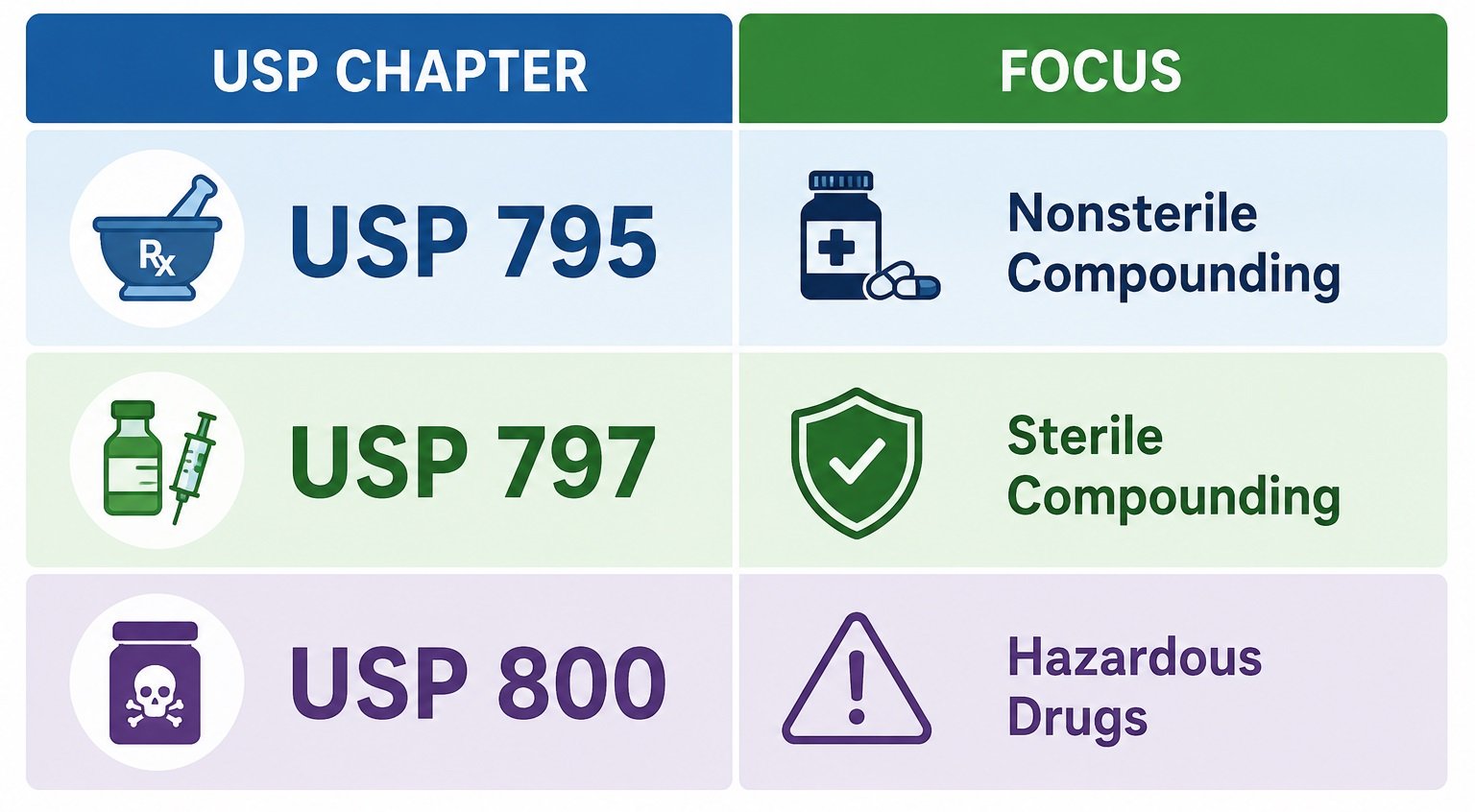
How do USP <795> and <797> shape the BUD?
- USP <795> covers non‑sterile compounding (like capsules, oral liquids, creams). It gives clear day‑limits for different formulations — for example, water‑containing oral preparations get 14 days at room temp or refrigerated.
- USP <797> focuses on sterile compounding (injectables, eye drops, etc.) with tighter BUD limits and stricter environmental controls.
Both chapters ensure that BUD assignment is standardized, evidence‑based decision that every compounding pharmacy can rely on.
What Is a Beyond-Use Date (BUD)?
Definition of Beyond-Use Date
Officially, a Beyond Use date (BUD) is the date or time after which a compounded preparation should not be used for human consumption. It’s set by the pharmacist based on when the drug was made, what type of formulation it is (powder, liquid, cream, etc.), and how it’s stored, room temperature, fridge, or freezer. Think of it as a custom expiration date for that specific batch.
Who Assigns a BUD?
BUD is assigned by the compounding pharmacist. They look at USP guidelines, the drug’s properties, and the storage conditions to pick a safe, defensible date, and they put it right on the label so everyone knows when to say “time to toss it.”
Factors That Affect Beyond-Use Dates
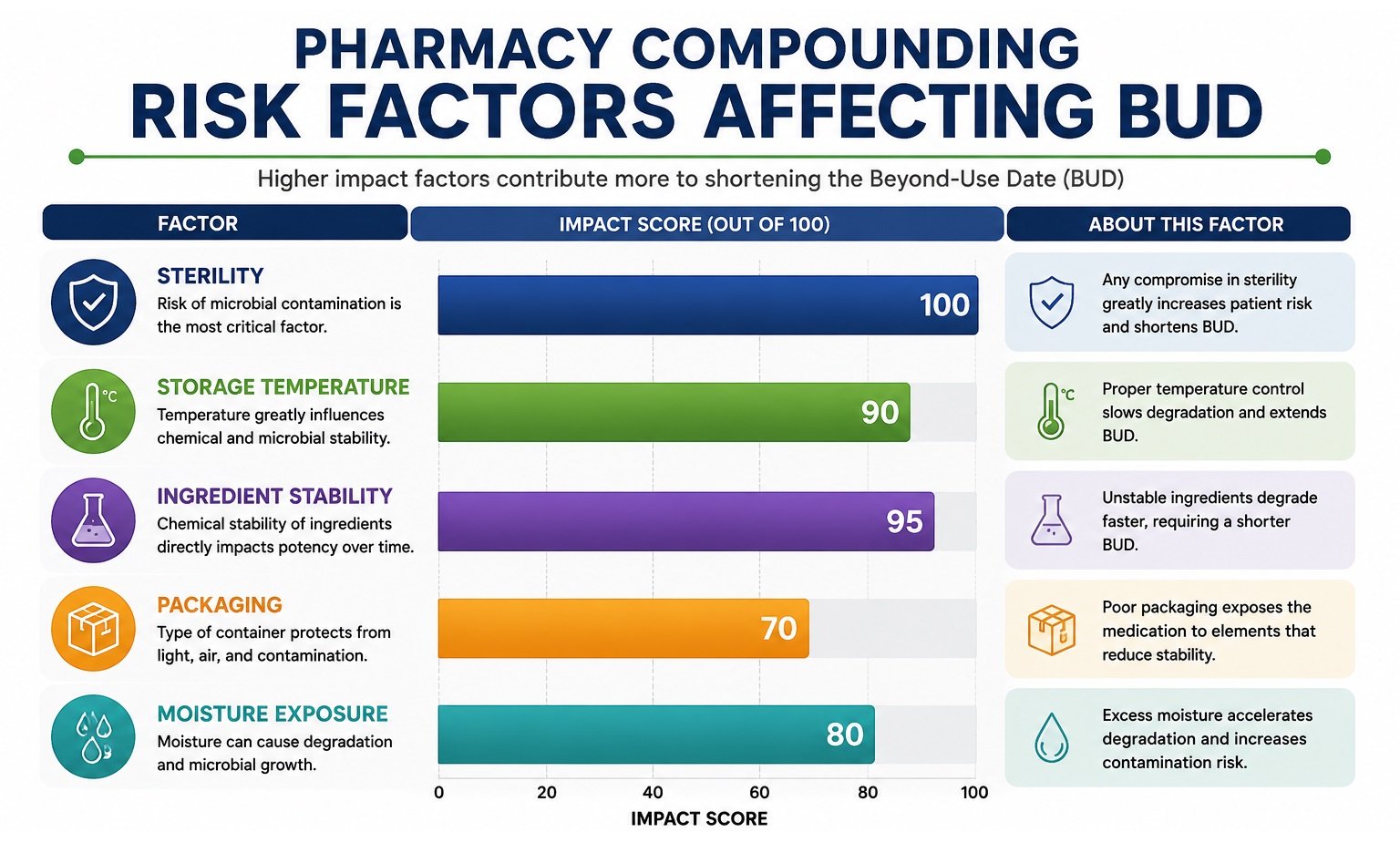
A BUD isn’t pulled from thin air, in-fact several real-world factors come into play.
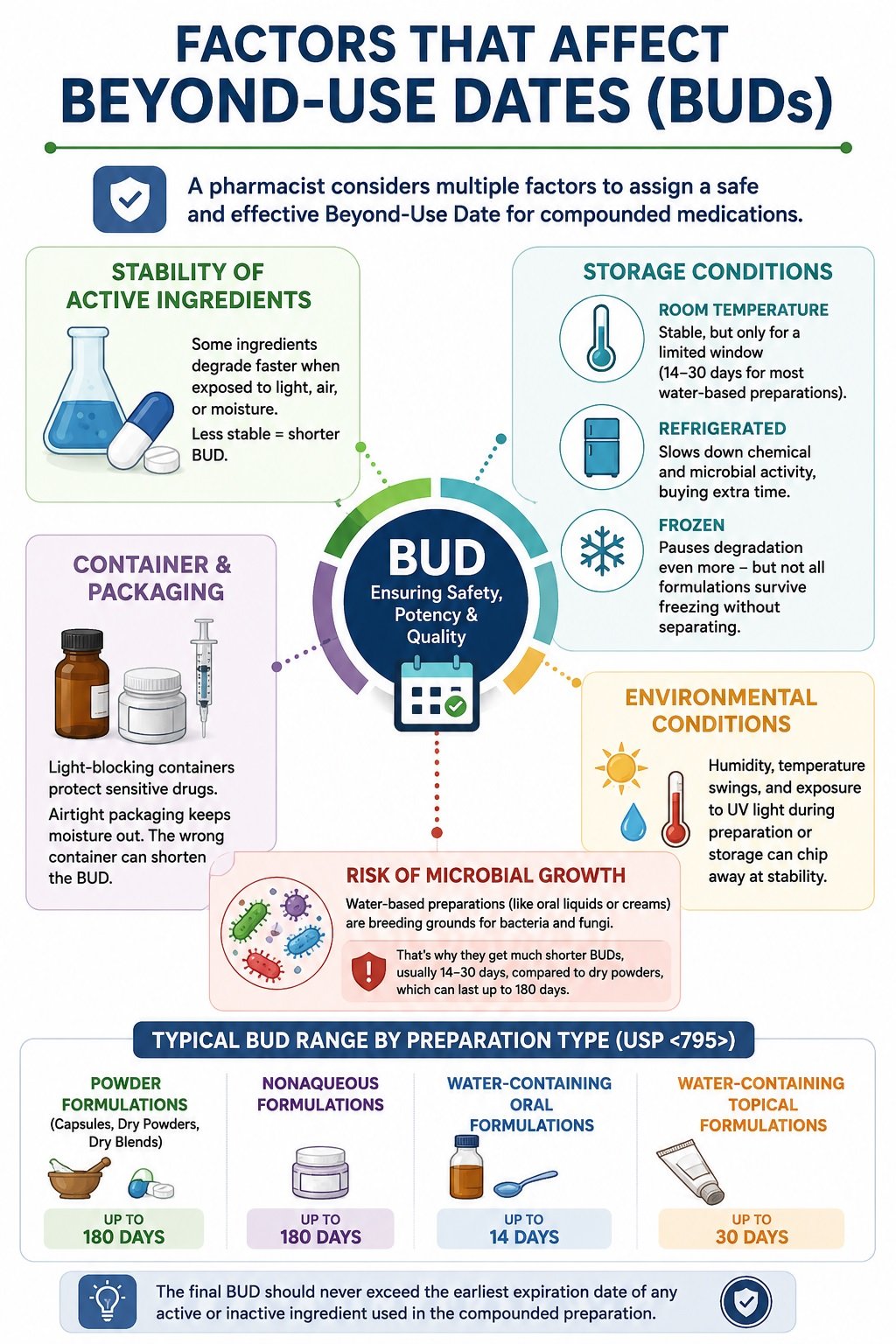
Stability of Active Ingredients
Some drug molecules are tough; others break down quickly when exposed to light, air, or moisture. If an ingredient is known to degrade fast, the pharmacist shortens the BUD to make sure you’re getting the full dose.
Storage Conditions
Where you keep the medicine changes everything.
- Room Temperature: Stable, but only for a limited window (e.g., 14–30 days for most water-based preparations).
- Refrigerated: Slows down chemical and microbial activity, buying extra time.
- Frozen: Pauses degradation even more – but not all formulations survive freezing without separating.
Container and Packaging
Is it in an amber glass bottle, a plastic syringe, or a cream jar? Light-blocking containers protect sensitive drugs, while airtight packaging keeps moisture out. The wrong container can shorten the BUD fast.
Environmental Conditions
Humidity, temperature swings, and even exposure to UV light during preparation or storage can chip away at stability.
Risk of Microbial Growth
Water-based preparations (like oral liquids or creams) are breeding grounds for bacteria and fungi. That’s why they get much shorter BUDs, usually 14–30 days, compared to dry powders, which can last up to 180 days.
Common Examples of Beyond-Use Dates
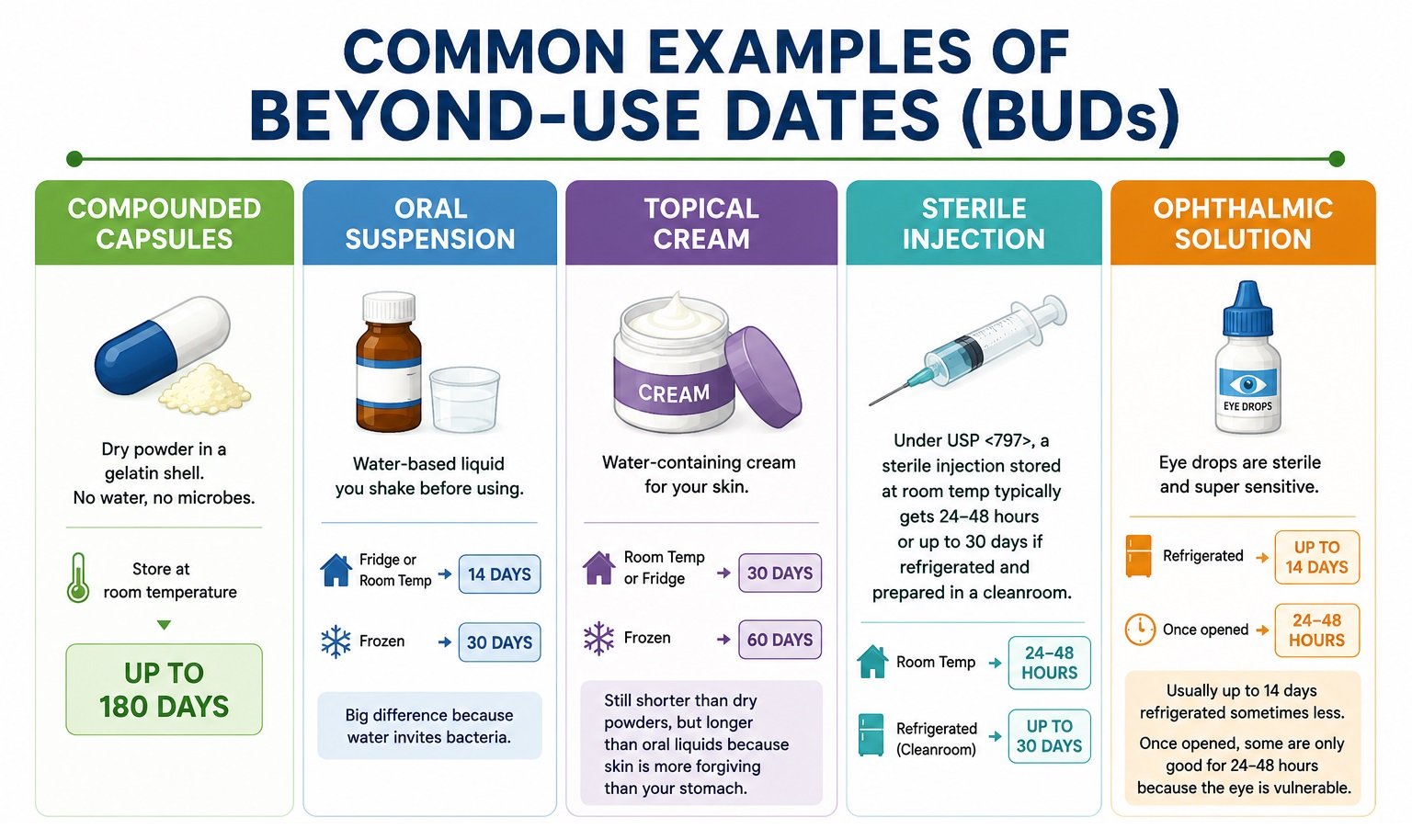
Compounded Capsules
Dry powder in a gelatin shell. No water, no microbes. Store at room temperature → up to 180 days.
Oral Suspension
Water-based liquid you shake before using.
- Fridge or room temp → 14 days.
- Pop it in the freezer → 30 days.
Big difference because water invites bacteria.
Topical Cream
Water-containing cream for your skin.
- Room temp or fridge → 30 days.
- Frozen → 60 days.
Still shorter than dry powders, but longer than oral liquids because skin is more forgiving than your stomach.
Sterile Injection
Under USP <797>, a sterile injection stored at room temp typically gets 24–48 hours or up to 30 days if refrigerated and prepared in a cleanroom.
Ophthalmic Solution
Eye drops are sterile and super sensitive. Usually up to 14 days refrigerated sometimes less. Once opened, some are only good for 24–48 hours because the eye is vulnerable.
Frequently Asked Questions About Beyond-Use Dates (BUDs)
What is a Beyond-Use Date (BUD)?
A Beyond-Use Date (BUD) is the date or time after which a compounded medication should not be used. Unlike a manufacturer's expiration date, a BUD is assigned by a pharmacist based on USP standards, ingredient stability, storage conditions, and the type of compounded preparation.
Is a BUD the same as an expiration date?
No. An expiration date is assigned by the manufacturer based on extensive stability testing of a commercially manufactured product. A Beyond-Use Date is assigned to a compounded preparation and is generally shorter because compounded medications do not undergo the same long-term stability studies.
Who determines the BUD?
A licensed pharmacist determines the Beyond-Use Date using current USP guidelines, ingredient expiration dates, available stability data, storage conditions, packaging, and other factors that may affect the quality and safety of the compounded medication.
What USP chapters cover Beyond-Use Dates?
USP <795> provides guidance for assigning Beyond-Use Dates to nonsterile compounded preparations, while USP <797> establishes requirements for sterile compounded preparations. These chapters help pharmacies assign appropriate BUDs to ensure patient safety.
What is the BUD for compounded capsules?
Compounded capsules are generally considered nonaqueous formulations under USP <795>. Unless otherwise supported by stability data or ingredient expiration dates, a BUD of up to 180 days may be assigned. Pharmacists must also consider the expiration dates of all ingredients used.
What is the BUD for oral suspensions?
Water-containing oral formulations, such as oral suspensions and solutions, are commonly assigned a BUD of up to 14 days when stored under refrigeration, unless stability data supports a different date.
What is a CSP?
CSP stands for Compounded Sterile Preparation. Examples include IV admixtures, sterile injections, ophthalmic solutions, and other sterile medications prepared in compliance with USP <797> standards.
Can a BUD exceed an ingredient expiration date?
No. A Beyond-Use Date should never exceed the earliest expiration date of any active or inactive ingredient used in the compounded preparation. The final assigned BUD must consider both USP guidelines and ingredient expiration dates.
How does freezing affect a BUD?
Freezing may extend the allowable Beyond-Use Date for certain sterile compounded preparations when supported by USP guidelines and stability data. However, not all medications remain stable when frozen, so pharmacists must verify compatibility and storage requirements.
What factors affect the assignment of a Beyond-Use Date?
Several factors influence BUD assignment, including the type of formulation, sterility requirements, ingredient stability, storage conditions, container type, risk of microbial contamination, packaging, and the expiration dates of ingredients. Pharmacists must evaluate all of these factors before assigning a final BUD.
References and Resources
-
USP General Chapter <795> – Pharmaceutical Compounding: Nonsterile Preparations
Guidance from the United States Pharmacopeia (USP) on quality standards, procedures, and beyond-use dating for nonsterile compounded medications. -
USP General Chapter <797> – Pharmaceutical Compounding: Sterile Preparations
Official USP standards for sterile compounding, including environmental controls, personnel training, and beyond-use date requirements for compounded sterile preparations (CSPs). -
U.S. Food and Drug Administration (FDA) – Human Drug Compounding
FDA information on pharmacy compounding, patient safety, regulatory requirements, and oversight of compounded medications. -
Texas State Board of Pharmacy – Pharmacies Compounding Sterile Preparations
Texas pharmacy regulations and requirements related to sterile compounding, quality assurance, documentation, and compliance standards. -
National Association of Boards of Pharmacy (NABP) – USP Compounding Standards
Overview of pharmacy accreditation and compliance with USP <795>, USP <797>, and USP <800> standards. -
USP Recognition of Compounding Standards
Information on USP compounding standards, legal considerations, and the role of USP chapters in supporting safe pharmacy compounding practices.
Medical Review & Calculator Development
This calculator and its related educational content have been verified by Adesh Pundir, RPh, a licensed pharmacist in the State of Texas (License #54111) with professional pharmacy experience since 2013. Adesh also holds a Master’s Degree in Information Systems, combining healthcare expertise with advanced knowledge of technology, software development, and healthcare information systems.
His areas of expertise include pharmacy calculations, medication dosing algorithms, pharmaceutical compounding, pharmacy informatics, counseling, healthcare software solutions, and clinical decision-support systems. Each calculator is designed using established pharmacy principles, professional standards, USP guidelines where applicable, and evidence-based references to help improve calculation accuracy, educational value, and patient safety.
Disclaimer: This content is for educational purposes only and should not be considered medical advice. Always consult a qualified healthcare professional for personalized recommendations.