Body Mass Index Calculator / BMI Calculator for Adults
📐 Step‑by‑step calculation
💡 Steps to improve
What is Body Mass Index (BMI)
Body Mass Index (BMI) is a straightforward metric that is used to determine whether a person’s weight is appropriate for their height. Understanding this index makes it easier for medical professionals and people themselves to determine whether a patient is underweight, normal weight, overweight, or obese.
Main matrix used for BMI are weight and height that are used to compute BMI. It provides a general understanding of body weight and potential health problems, but it does not measure body fat directly, its an indirect measure.
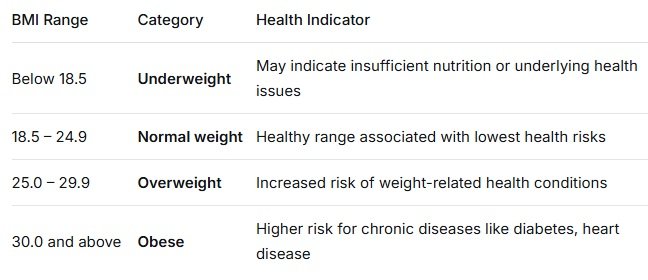
BMI Ranges for Adults (18+ years)
- Below 18.5 Underweight
- 18.5 – 24.9 Normal weight
- 25.0 – 29.9 Overweight
- 30.0 and above Obese
How to Interpret Your BMI Result
🔵 Underweight (BMI < 18.5)
- May need nutritional assessment
- Could indicate malnutrition, eating disorder, or other medical conditions
Action: Consult healthcare provider for weight gain strategies
🟢 Normal Weight (BMI 18.5 – 24.9)
- Optimal range for most adults
- Associated with lowest health risks
Action: Maintain healthy lifestyle with balanced diet and regular exercise
🟠 Overweight (BMI 25.0 – 29.9)
- Moderate health risk
- May lead to high blood pressure, type 2 diabetes, or heart disease
Action: Consider weight management through diet and increased physical activity
🔴 Obese (BMI ≥ 30.0)
- High health risk
- Significantly increased risk for cardiovascular disease, diabetes, sleep apnea, and joint problems
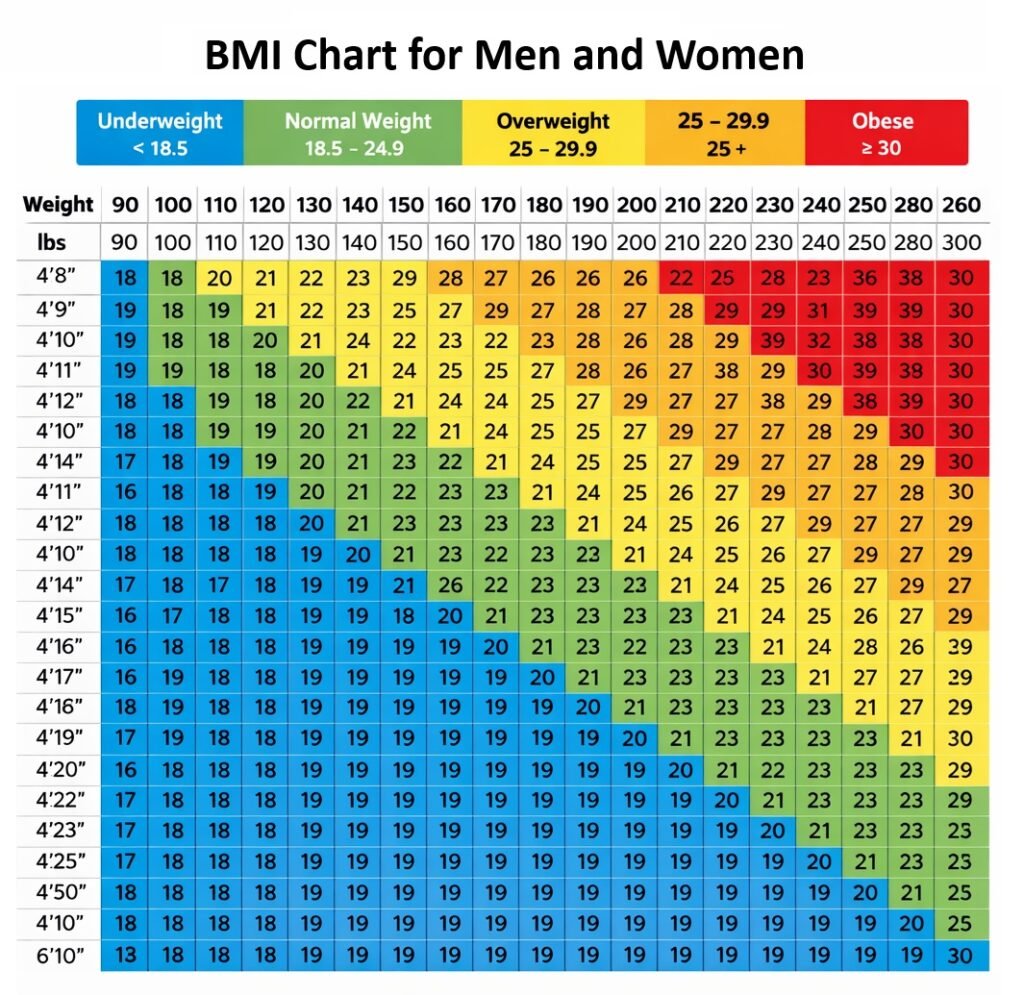
BMI Table for Men and Women
Simply put, a BMI table is a chart that displays body mass index values. Your BMI is determined by taking your height on one side and your weight on the other. Underweight is represented by light green, normal by green, overweight by orange, and obese by red in the color-coded zones of the table. You don’t have to perform any math. You can see where you fall by simply looking at the chart. Because they provide a fast snapshot, these tables are common at gyms and doctor’s clinics. But keep in mind that the table is unable to determine if you have muscle or fat in various areas. It’s only the beginning of determining whether your weight is within a healthy range.
How is BMI Measured
Your height and weight are the only two factors that are used to calculate Body Mass Index (BMI). There is no specific equipment required, such as body fat calipers or an electrically powered scale. To measure your height, all you need is a reliable metered scale.
You first determine your weight in pounds or kilograms. Next, you can determine your height in feet, inches, centimeters, or meters or can convert from any unit. The formula divides your weight by the square of your height. Your BMI is the figure that appears.
BMI solely calculates your weight in relation to your height. It is unable to distinguish between muscle and fat. Therefore, two individuals with the same BMI may have very distinct bodies.
Body Mass Index (BMI) Formula Online
Although the BMI formula is actually rather easy math, no one wants to perform it by hand these days. In a matter of seconds, our online calculator complete the task for you.
The metric system is used in the standard formula. You divide your weight in kilograms by the square of your height in meters. Therefore, if you are 1.75 meters tall and weigh 70 kg, you divide 70 by 1.75 x 1.75 to get roughly 22.9.
The calculation is slightly different if pounds and inches are used. You divide the result by the square of your height in inches after multiplying your weight in pounds by 703. Thus, it’s the same concept with an integrated conversion factor.
The majority of online calculators allow you to select between imperial and metric units.
Different Body Mass Index (BMI) Formulas using US Units:
1. Formula Using Pounds and Inches (Most Common)
This is the most commonly used BMI formula in the United States.
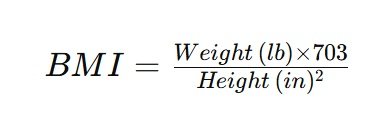
You multiply weight in pounds by 703, then divide by height in inches squared.
Example
Weight = 180 lbs
Height = 70 inches
BMI = (180 × 703) ÷ (70 × 70)
= 25.8 (Overweight)
Doctors and online BMI calculators mostly use this formula.
2. Formula Using Pounds and Feet
This formula is helpful when height is measured in feet instead of inches.
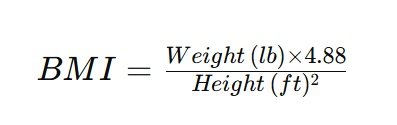
The number 4.88 is another conversion factor derived from 703.
Example
Weight = 180 lbs
Height = 5.8 ft
BMI = (180 × 4.88) ÷ (5.8²)
≈ 25.8
Same result, just easier if height is in feet.
3. Formula Using Pounds, Feet, and Inches
This formula is useful when height is written like 5 feet 10 inches.
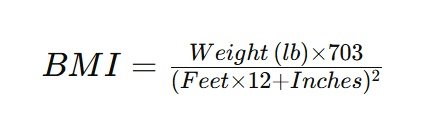
Example
Weight = 180 lbs
Height = 5 ft 10 in
Convert height to inches
(5 × 12) + 10 = 70 inches
BMI = (180 × 703) ÷ 70²
= 25.8
Body Mass Index (BMI) Formulas using Metric Units:
1. Formula Using Kilograms and Meters (Standard Formula)
This is the original and most commonly used BMI formula worldwide.
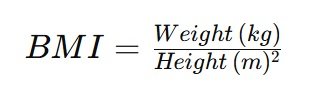
You divide weight in kilograms by height in meters squared.
Example
Weight = 70 kg
Height = 1.75 m
BMI = 70 ÷ (1.75 × 1.75)
= 22.9
This is considered Normal weight. Doctors and research studies mostly use this formula.
2. Formula Using Kilograms and Centimeters
This formula is helpful when height is measured in centimeters, which is very common in hospitals and clinics.
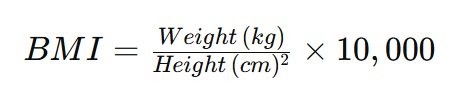
Example
Weight = 70 kg
Height = 175 cm
BMI = 70 ÷ (175 × 175) × 10,000
= 22.9
Same result, just easier when using centimeters.
3. Formula Using Grams and Centimeters
This formula is sometimes used in scientific studies or pediatric calculations where weight is measured in grams.
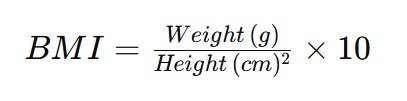
Example
Weight = 70,000 g
Height = 175 cm
BMI = 70,000 ÷ (175 × 175) × 10
= 22.9
Do BMI readings differ between men and women? Why or Why Not?
No, the BMI figures used by men and women are same. For both men and women, a BMI of 24 is regarded as normal. The BMI formula does not account for gender because it was developed using averages from sizable populations. Therefore, everyone above the age of eighteen falls into the same groups.
Here’s the catch, though. Naturally, the bodily compositions of men and women differ quite a bit. Typically, women have more body fat and males have greater muscle mass. Even if a man and a woman have the same body mass index, their appearances may differ a lot. Even when a strong man is quite fit, his body mass index may indicate that he is “overweight.” Because of this, some experts believe that BMI on its own isn’t always fair, yet the figures themselves remain the same regardless of gender.
