
FFMI Calculator (Fat-Free Mass Index) – Calculate Lean Muscle
What is FFMI
FFMI (Fat-Free Mass Index) is a measurement that estimates your muscle mass relative to your height, helping determine whether your physique is within natural limits.
Fat Free Mass Index (FFMI) focuses specifically on your lean body mass, that gives you a much clearer picture of your muscular development which is relative to your height of course. If you are aiming to build your muscles, evaluate your progress, or understand your natural limits, our calculator ot tool can provide you meaningful insight.
Calculate your FFMI instantly using your height, weight, and body fat percentage:
📊 FFMI Calculator
📋 Result Interpretation
Your FFMI Score
📈 Body Composition Metrics
📐 Step-by-Step Calculation
⚡ Adjust inputs to see real-time calculations and formulas.
FFMI Quick Summary
- Good FFMI: 20–22 (athletic range)
- Natural Limit: ~25 (men), ~21–22 (women)
- Best Use: Measure lean muscle mass and fitness level
Table of Contents
FFMI Categories & What Your Score Means
Below is a detailed breakdown of FFMI categories and what each range typically represents:
FFMI Below 18: Low Muscle Mass
FFMI below 18, generally indicates low lean body mass. This range is common among individuals who are sedentary, underweight, or new to resistance training.
👉 What it means:
- Limited muscle development
- Potential need for strength training
- May benefit from improved nutrition
👉 Recommended action:
- Focus on beginner strength training programs, increase protein intake, and maintain a calorie surplus to build muscle gradually.
FFMI 18–20: Average Physique
An FFMI between 18 and 20 reflects a normal or average body composition. This range is typical for individuals who are moderately active but not specifically training for muscle growth.
👉 What it means:
- Healthy but not highly muscular
- Room for improvement in muscle mass
👉 Recommended action:
Introduce structured resistance training and track your lean body mass progress over time.
FFMI 20–22: Athletic / Fit
This range is considered athletic and well-trained. Individuals here typically follow a consistent fitness routine and maintain a balanced diet.
👉 What it means:
- Visible muscle definition
- Good strength and conditioning
- Above-average fitness level
👉 Recommended action:
Continue progressive overload and optimize macronutrient intake to support further muscle gains.
FFMI 22–25: Advanced / Highly Muscular
An FFMI in this range indicates advanced muscle development. This is often seen in experienced lifters, bodybuilders, and athletes.
👉 What it means:
- High lean body mass
- Years of consistent training
- Near genetic potential for many individuals
👉 Recommended action:
Focus on training periodization, recovery optimization, and minimizing fat gain while building muscle.
FFMI Above 25: Above Natural Limit
An FFMI above 25 is often considered beyond the typical natural muscle limit, especially for men.
👉 What it means:
- Extremely high muscle mass
- Rare without exceptional genetics or enhancement
👉 Important note:
FFMI alone cannot confirm steroid use, but values above 25 are uncommon in natural lifters.
FFMI Categories Chart
| FFMI Score Range | Fitness Level | Muscle Mass Level | Body Composition Insight |
| Below 18 | Low / Underdeveloped | Low lean body mass | Indicates minimal muscle, higher fat ratio possible |
| 18 – 20 | Average | Moderate muscle mass | Normal body composition, limited muscle definition |
| 20 – 22 | Fit / Athletic | Good lean mass | Visible muscle, balanced fat-to-muscle ratio |
| 22 – 25 | Advanced | High muscle mass | Significant muscle development, near natural limit |
| Above 25 | Elite / Above Natural | Very high muscle mass | Rare naturally, may indicate enhanced physique |
What is a Good FFMI Score?
A good FFMI score is between 20 and 22, which indicates an athletic and well-trained physique. Most natural lifters fall within this range, while values above 25 are considered rare without enhancement.
How to Use the FFMI Calculator (Step by Step)
Step 1: Select your Gender
Choose Male or Female. This helps put your results in context, but the math itself works the same way.
Step 2: Choose your Unit System
Imperial
- Enter height in feet/inches, weight in pounds (lbs)
Metric
- Enter height in centimeters (cm), weight in kilograms (kg)
Step 3: Enter your Height
- Imperial: type feet (e.g., 5) and inches (e.g., 9)
- Metric: type cm (e.g., 175)
Step 4: Enter your Weight
- Imperial: type lbs (e.g., 165)
- Metric: type kg (e.g., 75)
Step 5: Enter your Body Fat %
- Type your estimated body fat percentage (e.g., 15%).
- Tip: essential fat is about 3% for males and 10% for females.
Step 6: View Results in Real Time
Results update automatically in real-time as you feed any value.
Step 7: Reset if Needed
Click the Reset to Defaults button to clear and start over.
Once calculated, your FFMI score will indicate where you fall on the muscle spectrum from below average to elite levels.
💡 Pro Tip: For best results, use an accurate body fat estimate (DEXA scan, calipers, or smart scale with caution).
What FFMI Result Means (Simple Explanations)
- Standard FFMI: Your Fat-Free Mass Index. Similar to BMI, but ignores fat weight. Higher is better for muscle.
- Normalized FFMI: Standard FFMI adjusted to a height of 1.8m (5’11”). Makes it fair to compare people of different heights.
- Fat Free Mass: The weight of everything in your body except fat (muscle, bones, organs, water).
- Lean Weight (LBM): Same as Fat Free Mass. Just another name.
- Total Body Fat: The actual weight of only your body fat.
👉 “Try our BMI Calculator”
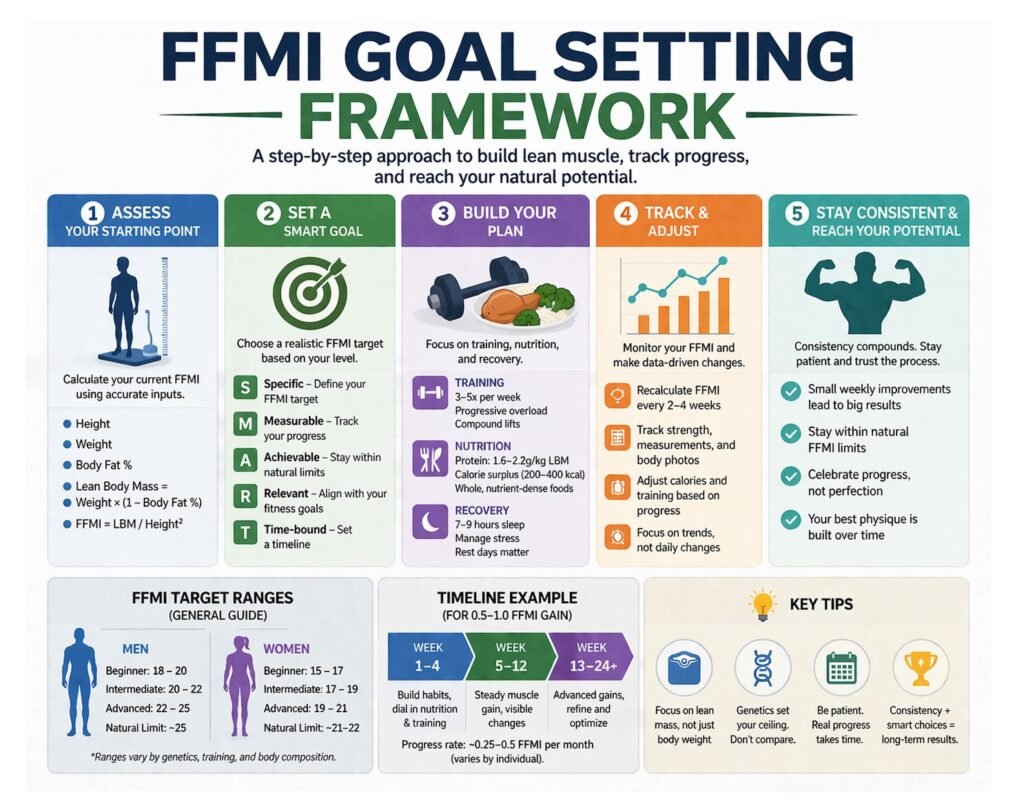
FFMI Goal Setting Framework
Setting clear goals is essential if you want to improve your FFMI in a structured and realistic way. Instead of guessing, you should use your current FFMI score to create a muscle gain plan that aligns with your fitness level, body composition, and long-term goals.
A simple and effective approach is to break your journey into phases – beginner, intermediate, and advanced and then focus on steady progress rather than quick results. This helps you build lean muscle mass, improve body composition, and avoid burnout.
FFMI Goal-Setting Framework (Step-by-Step)
- Step 1: Calculate your current FFMI using an accurate FFMI calculator
- Step 2: Identify your category (beginner, average, athletic, advanced)
- Step 3: Set a realistic target (increase FFMI by 1–2 points over time)
- Step 4: Follow a structured muscle building program (training + nutrition)
- Step 5: Track progress every 8–12 weeks
💡 Pro Insights:
Improving FFMI is a long-term process, not a quick fix. Most natural lifters can expect gradual increases with consistent strength training, proper nutrition, and recovery. By setting realistic goals and tracking your lean body mass, you can make steady and sustainable progress.
👉 Focus on consistency, not perfection: That is the key to increasing your FFMI naturally.
FFMI Goal-Setting Chart
| Current FFMI | Goal Range | Focus Area | Suggested Timeline |
| <18 | 18–20 | Build muscle foundation | 3–6 months |
| 18–20 | 20–22 | Lean muscle gain | 4–8 months |
| 20–22 | 22–24 | Advanced hypertrophy | 6–12 months |
| 22–25 | Maintain / refine | Strength + conditioning | Ongoing |
FFMI vs BMI – Key Differences Between FFMI and BMI
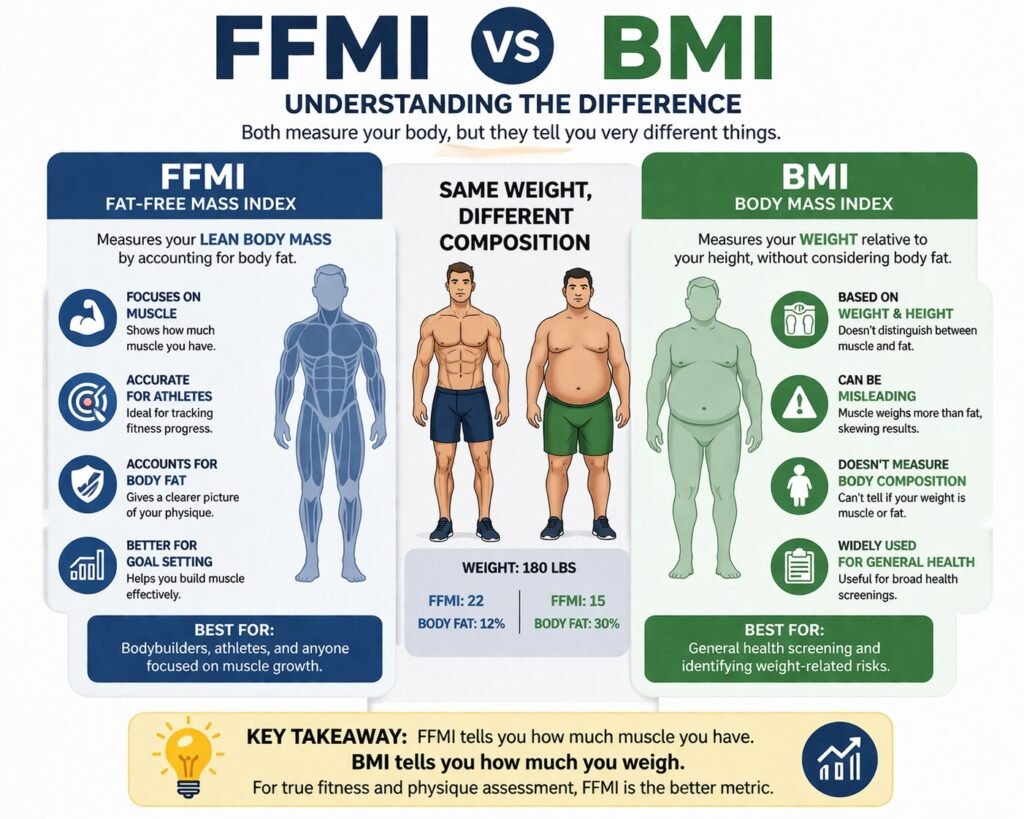
- BMI (Body Mass Index) is a simple calculation based on height and total body weight. While widely used in healthcare, it does not differentiate between fat and muscle mass.
- FFMI (Fat-Free Mass Index) improves upon BMI by incorporating lean body mass, making it far more relevant for fitness tracking.
| Feature | FFMI | BMI |
| Measures lean muscle mass | ✅ Yes | ❌ No |
| Accounts for body fat percentage | ✅ Yes | ❌ No |
| Accurate for athletes & bodybuilders | ✅ Highly accurate | ❌ Misleading |
| Useful for general population | ⚠️ Moderate | ✅ Commonly used |
| Reflects true body composition | ✅ Yes | ❌ No |
Real-World Example
A bodybuilder with high muscle mass may have a BMI of 28 (classified as overweight)
The same individual may have an FFMI of 23 (classified as athletic)
👉 This highlights how BMI can misclassify muscular individuals, while FFMI provides a true representation of muscle mass.
When to Use FFMI vs BMI
✔ Use FFMI if you want to:
- Track muscle growth
- Measure lean body mass
- Evaluate physique or bodybuilding progress
✔ Use BMI if you want to:
- Perform quick population-level screening
- Assess general weight categories
In modern fitness and sports science, FFMI is increasingly preferred because it aligns with body composition analysis, not just weight. As more people focus on muscle gain, fat loss, and metabolic health, FFMI provides a more meaningful and actionable metric.
💡 Expert Tip:
For best results, use FFMI alongside a body fat calculator and waist measurement to get a complete picture of your health and fitness.
Download FFMI vs BMI Comparison Chart (Free printable PDF)
FFMI for Men vs Women
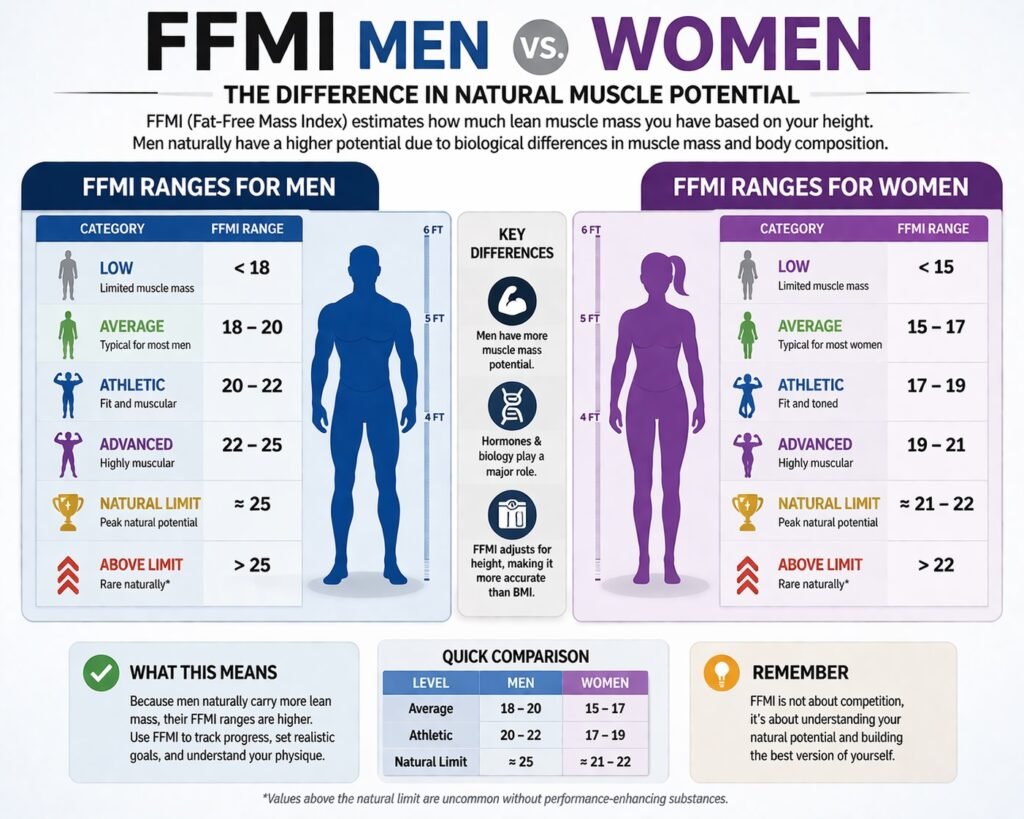
The FFMI (Fat-Free Mass Index) differs between men and women due to natural biological and hormonal differences. Men typically have higher levels of testosterone, which supports greater muscle mass and lean body development. Because of this, average and maximum FFMI values are generally higher in men compared to women.
For men, an FFMI between 20–22 is considered athletic, while values close to 25 are near the natural muscle limit.
In women, an FFMI of 17–19 is athletic, and 21–22 is considered close to the natural limit. These differences are completely normal and reflect how the body naturally builds muscle.
Key Differences Between Men and Women (Bullet Points)
- Men generally have higher FFMI scores due to greater muscle mass
- Women naturally have higher body fat percentages, which lowers FFMI
Hormonal differences (testosterone vs estrogen) impact muscle growth - Natural FFMI limit:
- Men: ~25
- Women: ~21–22
- FFMI is useful for both genders to track lean body mass and fitness progress
- Women should use female-specific FFMI charts for accurate comparison
What is a Good FFMI Score for Women?
A good FFMI score for women is typically between 17 and 19, which indicates an athletic and well-trained physique. Most women fall between 15 and 19, while values around 21–22 are considered close to the natural upper limit.
FFMI Chart Male vs Female
| Category | Men FFMI Range | Women FFMI Range | Interpretation |
| Low | <18 | <15 | Low muscle mass |
| Average | 18–20 | 15–17 | Normal physique |
| Athletic | 20–22 | 17–19 | Fit and toned |
| Advanced | 22–25 | 19–22 | Highly trained |
| Natural Limit | ~25 | ~21–22 | Genetic potential |
Natural FFMI Bodybuilding Limit: What Science Suggests
The natural FFMI bodybuilding limit refers to how much muscle a person can realistically build without performance-enhancing drugs. Based on research and observations of pre-steroid-era athletes, most experts suggest that a natural FFMI is usually around:
- Men: ~25 FFMI
- Women: ~21–22 FFMI
This doesn’t mean it’s impossible to go slightly above these numbers, but it is very rare and often depends on:
- Genetics, which play a huge role
- Body fat estimation errors can skew FFMI
- Height normalization may adjust values slightly
It’s also important to understand that FFMI is not a perfect tool.
 Reality Check:
An FFMI above 25 doesn’t automatically mean steroid use, but it does raise questions.
In simple terms:
If your FFMI is between 20–23, you’re likely in a strong, natural, and well-trained range.
“Research published on PubMed and NIH suggests that natural FFMI rarely exceeds 25 in men.”
1. Kouri et al. (1995) – Original FFMI Study (Natural Limit ~25)
2. NCAA / Sports Science Study (Supports FFMI Upper Limit ~25)
Body Fat % Impact on FFMI
Your body fat percentage plays a major role in determining how accurate your FFMI (Fat-Free Mass Index) calculation is. Since FFMI is based on lean body mass, even a small error in body fat estimation can significantly affect your final score. This is why using an accurate method to measure body fat is very important when using an FFMI calculator. For example, if your body fat percentage is overestimated, your lean mass will appear lower, which reduces your FFMI. On the other hand, underestimating body fat can make your FFMI look higher than it actually is. This can lead to incorrect conclusions about your muscle mass, fitness level, and natural muscle potential.Body Fat % vs FFMI Chart
| Body Fat % | Effect on FFMI | Accuracy Level |
| 10–12% | High FFMI accuracy | Very accurate |
| 15–18% | Moderate FFMI accuracy | Good estimate |
| 20–25% | Lower FFMI accuracy | Less reliable |
| 25%+ | Distorted FFMI values | Poor accuracy |
How to Improve Your FFMI (Proven Strategies)
🏋️ Training Strategy (Improve FFMI)
To improve your FFMI, focus on building muscle through strength training. The best approach is progressive overload, which means slowly increasing weight or reps over time.
Best exercises:
- Squats
- Deadlifts
- Bench press
- Pull-ups
👉 Aim for 3–5 sessions per week with proper programming.
🍽️ Nutrition Strategy (Improve FFMI)
Your diet plays a major role in increasing lean muscle mass and FFMI. Without proper nutrition, muscle growth will be limited.
✔ Protein intake: 1.6–2.2 grams per kg of body weight
✔ Calorie surplus: 250–500 extra calories daily
✔ Balanced macros: Protein + carbs + healthy fats
👉 Think of food as fuel. If your body doesn’t get enough nutrients, it cannot build muscle effectively.
😴 Recovery Strategy (Improve FFMI)
Recovery is often ignored, but it is essential for muscle growth and improving FFMI. Muscles repair and grow during rest, not during workouts.
✔ Sleep: 7–9 hours per night
✔ Rest days: At least 1–2 per week
✔ Avoid overtraining: Watch for fatigue and plateau
👉 Overtraining can slow progress. Giving your body time to recover helps you build stronger and leaner muscles.
💡 Unique Insight (Rarely Mentioned):
Track FFMI every 8–12 weeks, not weekly. Short-term fluctuations in water, glycogen, and body fat can distort results.
⚠️ Limitations of FFMI
FFMI is a useful tool, but it has some limitations you should understand.
- It depends on accurate body fat measurement
- Small errors can change your FFMI score
- It does not measure strength or performance
- Not ideal for beginners with fluctuating body composition
👉 FFMI should be used along with other metrics like body fat %, strength levels, and overall fitness for better understanding.
FFMI in Medical & Fitness Practice
1. Used by Professionals
The FFMI (Fat-Free Mass Index) is not just for gym users—it is also widely used by healthcare and fitness professionals to better understand lean body mass and muscle development.
- Sports medicine doctors use FFMI to evaluate an athlete’s muscle mass, recovery, and physical condition. It helps them identify imbalances, prevent injuries, and monitor long-term performance.
- Dietitians and nutritionists rely on FFMI to create personalized plans focused on muscle gain, fat loss, and body composition improvement. Unlike BMI, FFMI gives a clearer picture of how much of your weight is actually muscle.
- Strength and conditioning coaches use FFMI to track progress in athletes and clients. It helps them design better training programs, muscle-building strategies, and performance goals.
👉 Overall, FFMI is a valuable tool because it focuses on lean muscle mass, making it more useful than traditional weight-based measurements for both health and fitness tracking.
2. Applications
FFMI plays an important role in both medical and fitness settings because it helps measure true body composition, not just weight.
Monitoring muscle loss (sarcopenia):
Doctors use FFMI to detect loss of muscle mass, especially in older adults. This helps in early diagnosis and treatment of sarcopenia, which can affect strength and mobility.Evaluating obesity treatment progress:
During weight loss programs, FFMI helps ensure that patients are losing fat instead of muscle. This is important for maintaining metabolism and overall health.Assessing athlete conditioning:
Coaches and trainers use FFMI to evaluate whether an athlete has the right balance of muscle mass and body fat. It helps optimize performance, strength, and endurance.
👉 In simple terms, FFMI is a powerful tool for tracking muscle health, fitness progress, and body composition changes in a more accurate way than BMI.
Frequently Asked Questions (FAQs)
What is a good FFMI score?
A good FFMI score is usually between 20 and 22, indicating an athletic and well-trained physique.
Is FFMI better than BMI?
Yes, FFMI is more accurate because it measures lean body mass instead of total weight like BMI.
What is the natural FFMI limit?
The natural FFMI limit is around 25 for men and 21 to 22 for women.
Can FFMI detect steroid use?
No, FFMI cannot confirm steroid use, but very high values may suggest it.
How accurate is FFMI?
FFMI is accurate if body fat percentage is measured correctly.
How often should I calculate FFMI?
Every 2–3 months is ideal to track real progress.
What FFMI is considered athletic?
An FFMI between 20 and 22 is considered athletic.
Is FFMI different for men and women?
Yes, women typically have lower FFMI values than men.
Can beginners use FFMI?
Yes, but results may vary due to early body changes.
How do I increase my FFMI naturally?
Focus on strength training, proper nutrition, and recovery.
Does FFMI account for body fat?
Yes, it uses lean body mass, which excludes body fat.
What tools measure body fat for FFMI?
DEXA scans, calipers, and smart scales are commonly used.
Download FFMI FAQs (12 Most Common Questions Asked – Free PDF)
References
-
UC Davis Health – Body Composition & FFMI (DXA Information)
Provides an overview of body composition, lean mass, and fat-free mass index (FFMI), helping explain how muscle mass and body fat are measured in clinical practice.
-
NIH / PubMed Central – Fat-Free Mass Index and Body Composition Analysis
Explains how FFMI improves assessment of body composition compared to BMI and helps identify differences in muscle mass and health status.
-
NIH / PubMed Central – FFMI Classification and Reference Values
Provides FFMI ranges for men and women, supporting classification of muscle mass levels and helping with fitness goal setting and interpretation.
Medical Review & Author Information
Author: Adesh Pundir, RPh
License: Licensed Pharmacist, Texas State Board of Pharmacy
This content has been written and reviewed by a licensed pharmacist with over a decade of experience in healthcare and medication management. The information provided is based on scientific research, clinical knowledge, and evidence-based guidelines to ensure accuracy and reliability.
Our Content Process
- Evidence-based medical and fitness research
- Reviewed for accuracy and clarity
- Regular updates to reflect latest guidelines
Disclaimer
This content is for educational purposes only and should not be considered medical advice. Always consult a qualified healthcare professional for personalized recommendations.