
Calculate Lean Body Mass Using Boer, James & Hume Formulas
⚡ Lean Body Mass Calculator real‑time
📐 Step‑by‑step calculation
Boer Formula for Lean Body Mass Calculation
The Boer Formula is a mathematical equation used to estimate Lean Body Mass (LBM) from a person's height, weight, and gender. Developed by Peter Boer in 1984, it is widely used in healthcare, nutrition, and medication dosing to determine the amount of non-fat tissue in the body.
Boer Formula for Men:
LBM = (0.407 × Weight in kg) + (0.267 × Height in cm) − 19.2
Boer Formula for Women:
LBM = (0.252 × Weight in kg) + (0.473 × Height in cm) − 48.3
Example: A male weighing 80 kg and measuring 180 cm tall would have an estimated lean body mass of approximately 61.7 kg using the Boer Formula.
James Formula for Lean Body Mass Calculation
The James Formula is a mathematical equation used to estimate Lean Body Mass (LBM) based on a person's height, weight, and gender. Developed by W. P. T. James in 1976, it helps estimate the body's non-fat mass and is commonly used in nutrition studies, body composition assessments, and healthcare calculations.
James Formula for Men:
LBM = (1.1 × Weight in kg) − 128 × (Weight ÷ Height in cm)²
James Formula for Women:
LBM = (1.07 × Weight in kg) − 148 × (Weight ÷ Height in cm)²
Example: A male weighing 80 kg and measuring 180 cm tall would have an estimated lean body mass of approximately 63.0 kg using the James Formula.
Hume Formula for Lean Body Mass Calculation
The Hume Formula is a mathematical equation used to estimate Lean Body Mass (LBM) from a person's height, weight, and gender. Developed by R. Hume in 1966, it helps determine the body's non-fat mass and is widely used in healthcare, nutrition assessments, and medication dosing calculations.
Hume Formula for Men:
LBM = (0.32810 × Weight in kg) + (0.33929 × Height in cm) − 29.5336
Hume Formula for Women:
LBM = (0.29569 × Weight in kg) + (0.41813 × Height in cm) − 43.2933
Example: A male weighing 80 kg and measuring 180 cm tall would have an estimated lean body mass of approximately 57.1 kg using the Hume Formula.
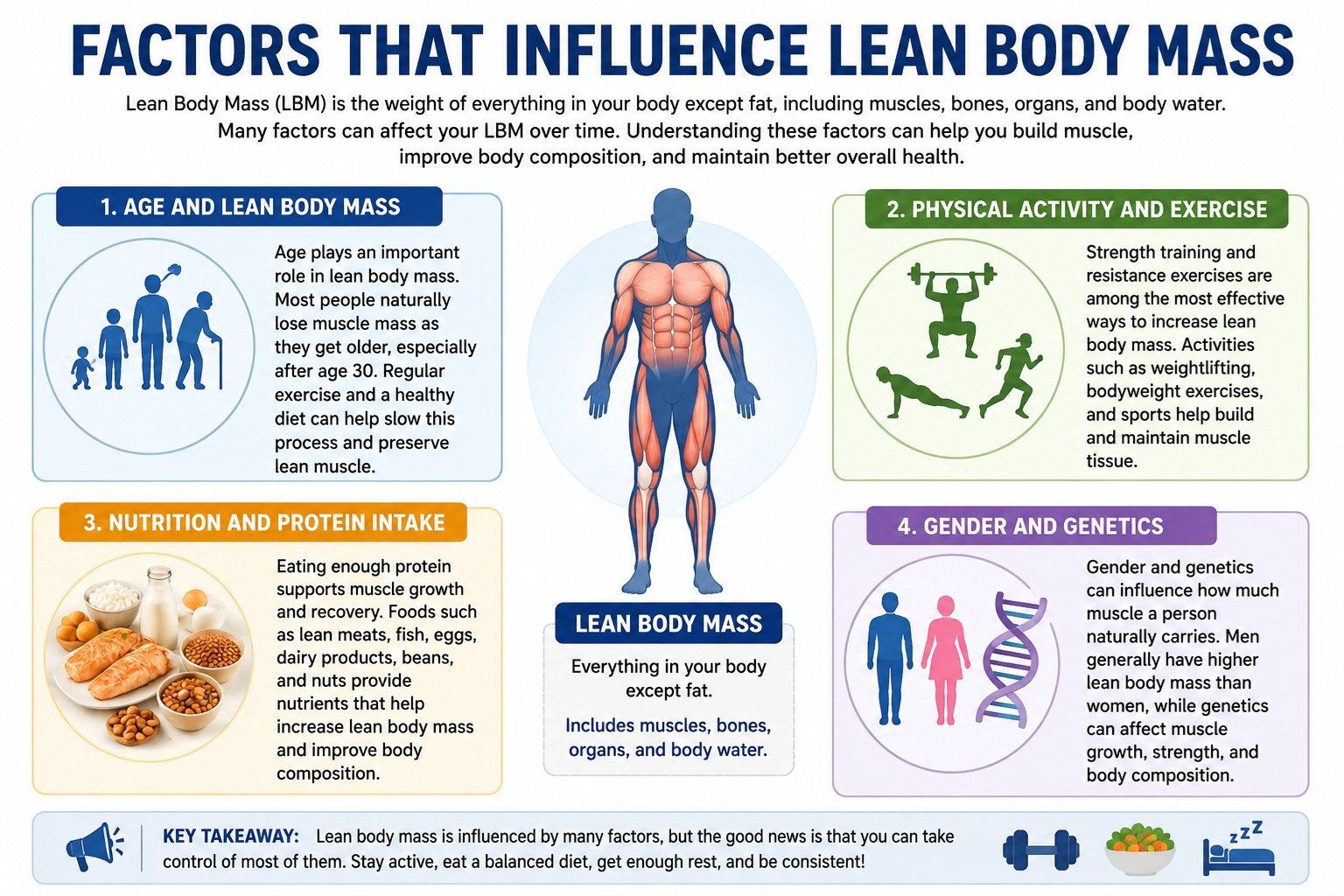
Factors That Influence Lean Body Mass
Lean Body Mass (LBM) is the weight of everything in your body except fat, including muscles, bones, organs, and body water. Many factors can affect your lean body mass over time. Understanding these factors can help you improve body composition, increase muscle mass, and maintain better overall health. A Lean Body Mass Calculator can help you estimate your LBM and track changes as your fitness level improves.
Age and Lean Body Mass
Age plays an important role in lean body mass. Most people naturally lose muscle mass as they get older, especially after age 30. Regular exercise and a healthy diet can help slow this process and preserve lean muscle.
Physical Activity and Exercise
Strength training and resistance exercises are among the most effective ways to increase lean body mass. Activities such as weightlifting, bodyweight exercises, and sports help build and maintain muscle tissue.
Nutrition and Protein Intake
Eating enough protein supports muscle growth and recovery. Foods such as lean meats, fish, eggs, dairy products, beans, and nuts provide nutrients that help increase lean body mass and improve body composition.
Gender and Genetics
Gender and genetics can influence how much muscle a person naturally carries. Men generally have higher lean body mass than women, while genetics can affect muscle growth, strength, and body composition.
What Is a Good Lean Body Mass?
A good lean body mass varies based on age, gender, and body size. Generally, lean body mass should account for most of your body weight, since it includes muscles, bones, organs, and body water. People with higher lean body mass often have better strength, metabolism, and overall fitness. Regular exercise and adequate protein intake can help maintain healthy lean body mass levels.
Healthy Lean Body Mass Percentage Range
| Category | Lean Body Mass (%) |
|---|---|
| Essential | 60–70% |
| Average Adult | 70–85% |
| Fit Individuals | 80–90% |
| Athletes | 85–95% |
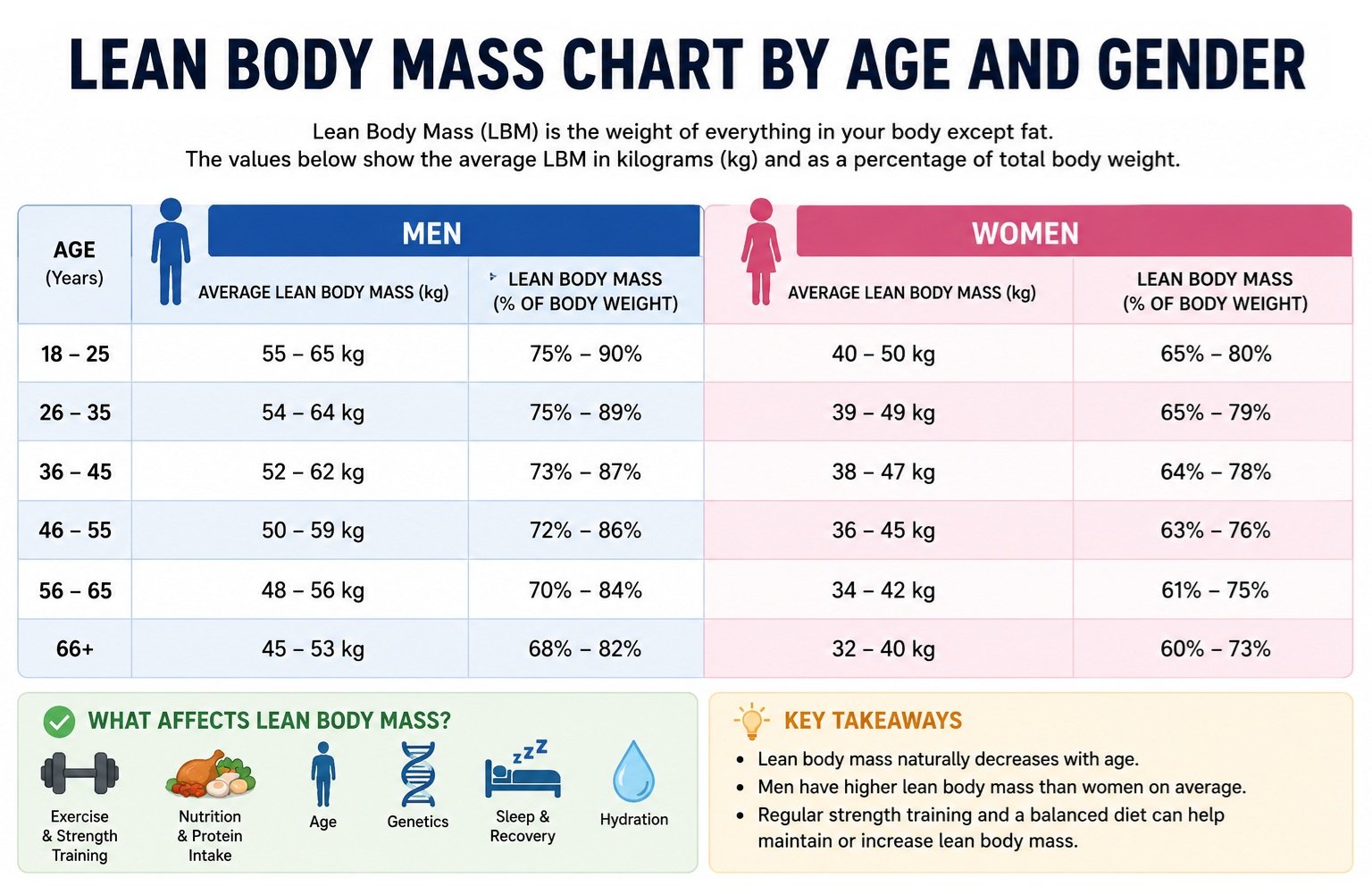
What is a healthy Lean Body Mass for Men
A healthy lean body mass for men is generally between 75% and 90% of total body weight. The exact amount varies based on age, height, body fat percentage, and fitness level. Men with higher lean body mass often have greater muscle mass, improved strength, and a faster metabolism.
Healthy Lean Body Mass Percentage Range for Men
| Fitness Level | Lean Body Mass (%) |
|---|---|
| Average Adult Male | 75–85% |
| Fit Male | 80–90% |
| Athlete | 85–95% |
What is a healthy Lean Body Mass for Women
A healthy lean body mass for women is generally between 65% and 85% of total body weight. The ideal range varies based on age, height, body fat percentage, and fitness level. Women with higher lean body mass often have greater muscle tone, improved strength, and a more efficient metabolism.
Healthy Lean Body Mass Percentage Range for Women
| Fitness Level | Lean Body Mass (%) |
|---|---|
| Average Adult Female | 65–75% |
| Fit Female | 70–85% |
| Female Athlete | 75–90% |
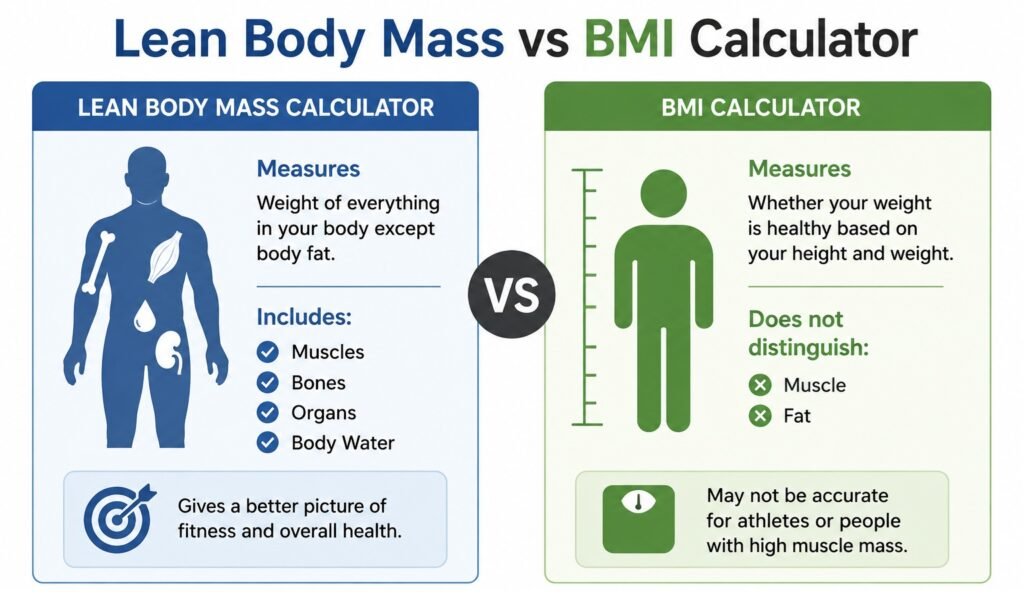
Lean Body Mass vs BMI Calculator
A Lean Body Mass (LBM) Calculator and a BMI Calculator both provide information about body composition, but they measure different things. BMI estimates whether your weight is healthy based on your height and weight, but it does not distinguish between muscle and fat.
Lean Body Mass measures the weight of muscles, bones, organs, and body water while excluding body fat. Because of this, LBM often provides a more detailed picture of fitness and overall health. For athletes and active individuals, Lean Body Mass can be a more useful measurement than BMI alone.
FAQS for Lean Body Mass Calculations
What is Lean Body Mass (LBM)?
Lean Body Mass (LBM) is the weight of everything in your body except fat. It includes muscles, bones, organs, connective tissues, and body water. LBM is commonly used to assess body composition and overall fitness.
How is Lean Body Mass calculated?
Lean Body Mass can be estimated using formulas such as the Boer Formula, James Formula, and Hume Formula. These formulas use factors like height, weight, and gender to estimate the amount of non-fat tissue in the body.
What is a healthy Lean Body Mass percentage?
A healthy Lean Body Mass percentage typically ranges from 75% to 90% for men and 65% to 85% for women. The ideal percentage varies based on age, fitness level, and body composition.
What is the difference between Lean Body Mass and Body Fat?
Lean Body Mass includes all body components except fat, while body fat refers only to stored and essential fat tissue. Together, Lean Body Mass and body fat make up your total body weight.
Is Lean Body Mass the same as Fat-Free Mass?
Lean Body Mass and Fat-Free Mass are similar but not identical. Lean Body Mass includes essential fat found in organs and tissues, whereas Fat-Free Mass excludes all fat from the calculation.
Why is Lean Body Mass important?
Lean Body Mass is important because it affects metabolism, physical strength, athletic performance, and calorie needs. People with higher lean body mass generally burn more calories at rest.
Can Lean Body Mass increase over time?
Yes. Lean Body Mass can increase through regular strength training, adequate protein intake, proper nutrition, and consistent physical activity. Building muscle is one of the most effective ways to increase LBM.
Does Lean Body Mass decrease with age?
Yes. Lean Body Mass naturally declines with age due to the gradual loss of muscle tissue. Regular exercise and a balanced diet can help slow this age-related decline.
Which Lean Body Mass formula is most accurate?
The Boer Formula is often considered one of the most accurate Lean Body Mass estimation formulas for adults. However, the best formula can vary depending on body type, age, and individual characteristics.
Can a Lean Body Mass Calculator help with weight loss goals?
Yes. A Lean Body Mass Calculator can help you understand your body composition, estimate calorie needs, set realistic fitness goals, and track changes in muscle mass during a weight loss or muscle-building program.
References
- National Center for Biotechnology Information (NCBI). Introduction and Background – Body Composition and Nutritional Status. Available at: https://www.ncbi.nlm.nih.gov/books/NBK235943/
- National Center for Biotechnology Information (NCBI). Methodologies for Measuring Body Composition in Humans. Available at: https://www.ncbi.nlm.nih.gov/books/NBK218181/
- University of New Mexico. Understanding Body Composition. Available at: https://www.unm.edu/~lkravitz/Article%20folder/underbodycomp.html
- University of California Davis Sports Medicine. Body Composition. Available at: https://health.ucdavis.edu/sports-medicine/resources/body-fat
Medical Review & Calculator Development
This calculator and its related educational content have been verified by Adesh Pundir, RPh, a licensed pharmacist in the State of Texas (License #54111) with professional pharmacy experience since 2013. Adesh also holds a Master’s Degree in Information Systems, combining healthcare expertise with advanced knowledge of technology, software development, and healthcare information systems.
His areas of expertise include pharmacy calculations, medication dosing algorithms, pharmaceutical compounding, pharmacy informatics, counseling, healthcare software solutions, and clinical decision-support systems. Each calculator is designed using established pharmacy principles, professional standards, USP guidelines where applicable, and evidence-based references to help improve calculation accuracy, educational value, and patient safety.
Disclaimer: This content is for educational purposes only and should not be considered medical advice. Always consult a qualified healthcare professional for personalized recommendations.