
Right Triangle Calculator (Pythagorean Theorem Solver)
Triangle Right Angle Calculator
Calculate the sides, angles, area, and perimeter of any right triangle
Enter Triangle Values
Triangle Visualization
Calculation Results
Right Triangle Formulas
For right triangle with sides a, b and hypotenuse c:
Formula for area of a right triangle:
Perimeter of a right triangle:
How to Use the Right Triangle Calculator (Step by Step)
This calculator solves for any missing side, angle, area, or perimeter of a right triangle. You only need to provide two pieces of information (besides the right angle).Step 1 – Know your right triangle parts
- Side a = one leg (adjacent to right angle)
- Side b = the other leg
- Side c = hypotenuse (longest side, opposite the 90° angle)
- Right angle (A) = always 90°
Step 2 – Choose what you know
- Enter values into any two input fields (except the right angle, which is fixed).
Find Perimeter
- You know both legs (a and b)
- Enter values for Side a and Side b
- Hypotenuse (c) using c = √a2 + b2
- Both acute angles (B and C)
- Area = 1/2 × a × b
- Perimeter = a + b + cThe calculator will automatically find:
Find missing angle
-
-
- You know one leg + the hypotenuse
- Example: enter Side a and Hypotenuse (c)
- Hypotenuse (c) using c = √c2 – a2
- Both acute angles
- Area and perimeterThe calculator finds:
-
Find missing sides
-
-
-
- You know one side + one acute angle
- Example: enter Side a and Angle B
- The calculator finds:
- All missing sides using sine/cosine/tangent
- The other acute angle (angles sum to 90°)
- Area and perimeter
-
-
Step 3 – Read the results table
After entering your values, the results panel shows:- Side A, B, C: Lengths of both legs and hypotenuse
- Angle A: Always 90° (right angle)
- Angle B, C: The two acute angles (sum = 90°)
- Area: Space inside the triangle (square units)
- Perimeter: Total distance around the triangle
Step 4 – Check the visualization in calculator image
A triangle diagram updates automatically in our calculator where you can see the changes in real time, which side is which.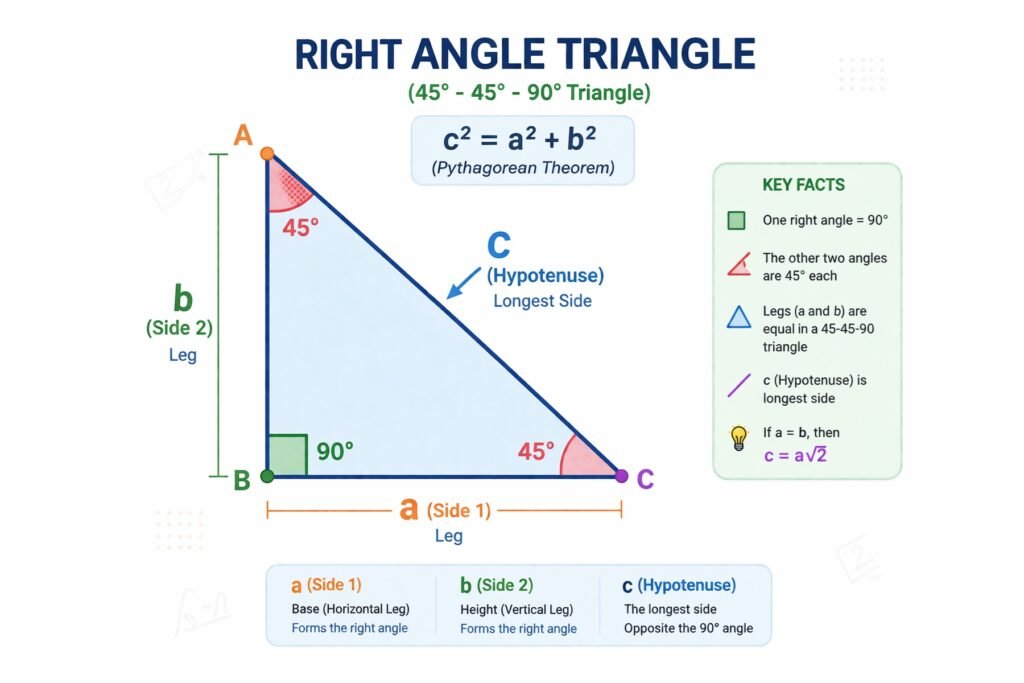
Formula: a² + b² = c² (Pythagorean theorem)
What is a right triangle?
A right triangle is a triangle with one corner that is exactly 90 degrees, or a right angle. The hypotenuse is the side that is opposite this angle, and it is always the longest side. Most of the time, the other two sides are called a and b.
In real life, you can find right triangles all over the place, like on ladders leaning against walls, roof slopes, and even paths for getting around. That’s why things like a triangle side calculator or a right triangle calculator are so helpful. They help you find missing sides quickly without having to do a lot of math.
It’s easy to find the third side if you know the other two. For instance, if you use a find hypotenuse calculator, you only need to type in the two shorter sides and you will get the answer right away. A lot of students and professionals also use a pythagorean theorem calculator to save time and avoid making mistakes.
A right triangle is the most useful and common type of triangle in math and everyday life.
Right Triangle Formula (Pythagorean Theorem)
Right Triangle Formula
In a right triangle, the square of side a plus the square of side b equals the square of the hypotenuse c.
The most important formula for a right triangle is the Pythagorean theorem. It helps you find the relationship between the three sides of the triangle.
Here, c is the hypotenuse (longest side), and a and b are the other two sides. This formula works only for right triangles.
If you want to find the hypotenuse, you can use a find hypotenuse calculator and simply enter values of a and b. If you already know the hypotenuse and one side, a triangle side calculator or pythagorean theorem calculator can help you find the missing side.
This formula is widely used in construction, engineering, and even everyday problem-solving. Instead of calculating manually every time, most people now prefer using a right triangle calculator for quick and accurate results.
In short, this formula is the backbone of all right triangle calculations.
How to Find Hypotenuse (c)
Hypotenuse Theorem Formula
Use this formula to find the hypotenuse of a right triangle when sides a and b are known.
Want to find the longest side of a right triangle?
First, take the two shorter sides (a and b) and multiply each by itself (that’s the “squared” part). Add those two results together and finally do the square root of the value. The answer is the hypotenuse length.
Example:
- Side a = 6
- Side b = 8
c = (6² = 36) + (8² = 64) = 100
c = √100 = 10 (hypotenuse)
Calculate Triangle Side Length (a or b)
Sometimes you already know the hypotenuse but need a missing leg. A triangle side calculator uses the reverse formula:
Formula: a = √(c² – b²) or b = √(c² – a²)
Start by squaring the hypotenuse (c). Then square the leg you do know. Subtract the smaller number from the larger one. Finally, take the square root. That gives you the missing side.
Example:
- Hypotenuse c = 10
- Side a = 6
- Formula: a = √(c² – b²) or b = √(c² – a²).
b = (10² = 100) – (6² = 36) or 100 – 36 = 64
b = √64 = 8 (missing side b)
Pythagorean Formula vs Hypotenuse Formula (Quick Comparison Table)
| Feature | Pythagorean Formula | Hypotenuse Formula |
| Formula | a² + b² = c² | c = √(a² + b²) |
| Purpose | Shows relationship between sides | Finds hypotenuse directly |
| Usage | General calculations | Specific to hypotenuse |
| Flexibility | Can find any side | Only finds c |
The hypotenuse formula is derived from the Pythagorean theorem and is used to quickly calculate the longest side of a right triangle.
Right Triangle Formula Comparison Table
| Type | Formula | Use |
|---|---|---|
| Pythagorean Formula | a² + b² = c² | Find relationship between sides |
| Hypotenuse Formula | c = √(a² + b²) | Find hypotenuse |
| Side Formula | a = √(c² − b²) | Find missing side |
Applications of Right Triangle Calculations
Right triangles aren’t just for math class. They show up everywhere in real life. A good triangle calculator saves time whether you are building a house, flying a plane, or even giving medicine. Let me show you how.
Construction
Carpenters use right triangles every single day. Need to make sure a wall is straight? Measure 3 feet along the wall and 4 feet out. The diagonal between those points should be exactly 5 feet. This is called the 3-4-5 rule. A pythagorean theorem calculator makes this even faster. Roof rafters, stair stringers, and foundation corners all depend on these same triangle rules.
Engineering
Bridges stay standing because engineers calculate forces using right triangles. When a weight pushes down on a bridge truss, the force splits along diagonal beams. Engineers use a distance formula calculator to figure out exact lengths before cutting any steel. The same math applies to ramps, cranes, and even roller coasters. Get the triangle wrong, and nothing works right.
Navigation
Pilots and ship captains rely on right triangles to find the shortest route. If a plane flies 100 miles east then 50 miles north, how far did it actually travel? A triangle calculator gives the direct diagonal distance. This saves fuel and time. The distance formula calculator does the same thing for hikers using a map. You never actually walk in a straight line, but right triangles tell you how close you came.
Pharmacy Dosing Geometry
This one surprises people. Pharmacists use right triangles to figure out how fast a liquid medicine spreads in the body. Drug concentration over time follows a right triangle pattern on a graph. The slope of the line helps calculate the correct dose for a child versus an adult. Geometry calculators help researchers model these curves without messy manual math.
Everyday Use
Any area calculator works best when you break a weird shape into smaller right triangles. Landscapers measure yards this way. Painters estimate wall space. Even sports coaches use right triangles to set up drills on a field. Geometry calculators take the guesswork out of all these tasks. Just type in two numbers and let the tool do the rest.

Frequently Asked Questions (Right Triangle Calculator)
1. What is the formula for a right triangle?
The formula is a² + b² = c². A right triangle calculator or pythagorean theorem calculator helps find missing sides quickly.
2. How do I find the hypotenuse of a triangle?
Use c = √(a² + b²). A find hypotenuse calculator gives instant results.
3. Can I find a missing side of a right triangle?
Yes, if you know two sides, you can find the third using the Pythagorean theorem or a triangle side calculator.
4. What is a hypotenuse in a right triangle?
The hypotenuse is the longest side opposite the 90-degree angle.
5. When can I use the Pythagorean theorem?
It is used only for right triangles to calculate side lengths.
6. How do I calculate the sides of a triangle easily?
Use a right triangle calculator to instantly find missing values.
7. What is the difference between a triangle calculator and a right triangle calculator?
A triangle calculator works for all triangles, while a right triangle calculator is specific to right-angled triangles.
8. Can I use this calculator for real-life problems?
Yes, it is useful in construction, engineering, navigation, and design.
9. Do I need to know all three sides to use a triangle calculator?
No, you only need two sides to calculate the third.
10. Is the Pythagorean theorem always accurate?
Yes, it provides exact results for right triangles.
11. Can you find a side without hypotenuse?
Yes, you can calculate the missing side if the other two sides are known.
12. What is the Pythagorean theorem used for?
It is used to calculate distances and side lengths in real-world applications.