
Suppository Calculation / Formula
⚕️ Suppository Calculator
✅ Required Quantities
Displacement Value · step by step calculation
What is Suppository Calculation Formula?
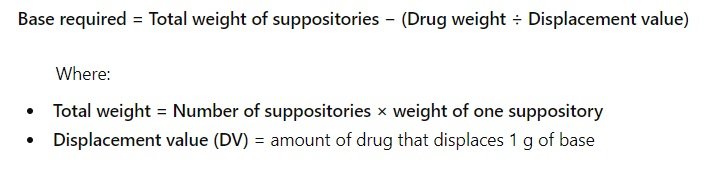
The main formula helps you figure out how much base you need when making suppositories with medicine in them. Here’s how it works:
First, you find out how much space the medicine takes up. You do this by taking the weight of medicine per suppository (in grams) and dividing it by the displacement value. This tells you how much base the medicine pushes out of the way.
Then, you take the mold capacity (how much the empty mold holds) and subtract that displaced base amount. That gives you the actual base needed for one suppository. Finally, multiply by how many suppositories you’re making to get your total base.
The formula looks like this:
Base per suppository = Mold capacity – (Medicine weight per suppository ÷ Displacement value)
Then multiply by quantity.
It sounds complicated, but once you practice a few times it starts to make sense.
How to calculate Suppository Base for Compounding?
To calculate how much base you need, start with the mold capacity. That’s the weight of a blank suppository made only of base.
Now, if you’re adding medicine, that medicine takes up some space. The displacement value tells you how much base is pushed aside by one gram of medicine. So you divide the medicine’s weight (in grams) by the displacement value to find out how much base gets displaced.
Then you subtract that displaced amount from the mold capacity. This gives you the base weight needed for one suppository.
Let’s say your mold holds 2 grams, your medicine is 0.1 grams per suppository, and the displacement value is 1.5. You do 0.1 ÷ 1.5 = 0.067 grams displaced. Then 2 – 0.067 = 1.933 grams of base per suppository. Multiply by how many you’re making, and you’ve got your total base.
How do I calculate the correct dose for a suppository?
The dose is simply how much medicine goes into each suppository. This is usually decided by a doctor or pharmacist based on the patient’s needs.
To calculate the total medicine needed for your batch, you just multiply the dose per suppository by the number of suppositories you’re making. For example, if each suppository needs 100 mg of medicine and you’re making 10 suppositories, you’ll need 1000 mg total.
The tricky part isn’t the dose math — it’s making sure that adding that medicine doesn’t throw off the suppository size. That’s where displacement value comes in. The dose stays the same, but the base amount gets adjusted so the final suppository fits the mold correctly.
Always double-check your dose with a pharmacist before compounding. Getting the dose wrong can make the suppository unsafe.
What is suppository displacement value?
Displacement value is a number that tells you how much space a medicine takes up inside a suppository mold.
Think of it like this: if you add medicine to the base, it pushes some of the base out of the way. The displacement value helps you figure out exactly how much base gets displaced. A value of 1 means one gram of medicine takes up the same space as one gram of base. If the value is higher, say 1.5, that means the medicine is denser and takes up less space, so it displaces less base.
This number is important because if you just add medicine to the base without adjusting, your suppositories might end up too big or too small. The displacement value lets you calculate the right amount of base so each suppository comes out the correct size and strength.
What are common suppository displacement values?
Displacement values vary depending on the medicine. They aren’t random, infact they’re based on the density of the active ingredient.
Common Suppository Displacement Values (DV)
- Aminophylline 1.1 – 1.3
- Aspirin (Acetylsalicylic acid) 1.1
- Balsam of Peru 0.83 – 1.0
- Bisacodyl 0.65
- Bismuth Subgallate 2.5 – 3.0
- Bismuth Subnitrate 0.3 – 0.33
- Boric Acid 0.63 – 0.67
- Caffeine 0.60 – 0.74
- Camphor 1.45 – 1.49
- Chloral Hydrate 0.66 – 0.67
- Hydrocortisone Acetate 0.73 – 1.5
- Ichthammol 0.91
- Lidocaine (base) 1.0
- Menthol 1.48
- Morphine Hydrochloride 0.65 – 0.83
- Paracetamol (Acetaminophen) 0.65 – 1.5
- Phenobarbital 0.81 – 0.82
- Zinc Oxide 0.15 – 4.8