
Suppository Compounding Calculator (Displacement Value Formula)
Suppository Compounding Calculator
✅ Required Quantities
Displacement Value · step by step calculation
What Are Suppository Calculations in Pharmacy?
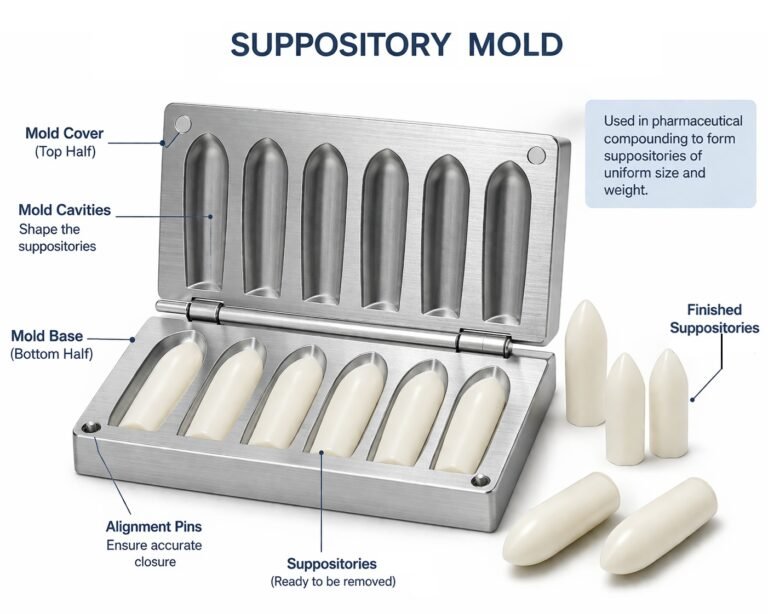
Pharmacists use suppository calculations to figure out how much medicine and base to mix together. You can’t just guess how much of each ingredient to use when you make a suppository from scratch. The medicine takes up space in the mold, so you have to adjust the quantity in the base so that the finished product fits perfectly.
If you don’t adjust the base quantity then your suppositories could be too big, too small, or too weak.
Compounding and Displacement Value.
Compounding is the process of making a custom medicine by mixing together ingredients from scratch. The displacement value is a number that shows how much base one gram of medicine pushes out of the way. If the displacement value is 1.5, that means the medicine is thick and only replaces about 0.67 grams of base for every gram of medicine. You use this number to figure out the exact base amount so that your suppository fits the mold correctly.
Suppository Displacement Value Formula
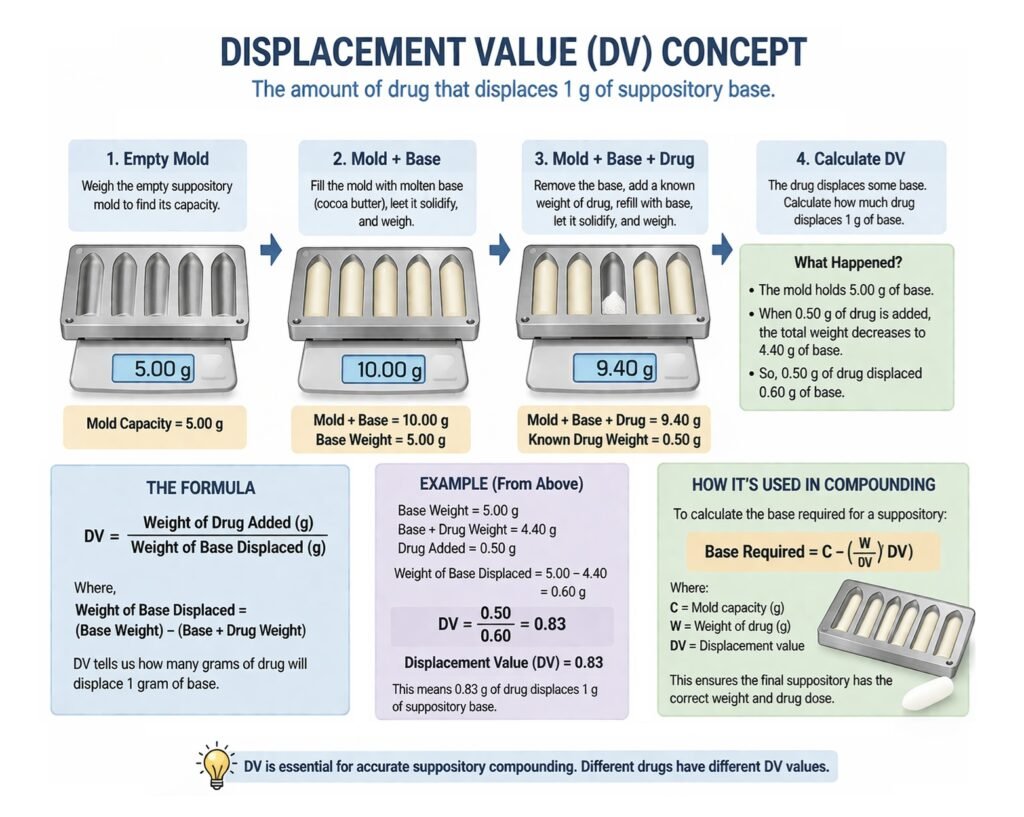
The displacement value formula helps you figure out how much base gets pushed aside when you add medicine to a suppository. It looks like this:
Base displaced = Weight of medicine (in grams) ÷ Displacement value
That’s the main formula you use during calculations.
It sounds complicated, but once you practice a few times it starts to make sense.
Suppository displacement value formula examples:
Say you have 0.2 grams of medicine going into each suppository, and the displacement value for that medicine is 1.4.
You plug the numbers into the formula: 0.2 ÷ 1.4 = about 0.143 grams
That 0.143 grams is how much base gets displaced, or pushed out, by the medicine. Once you know that number, you subtract it from the mold capacity to find out how much base you actually need.
For instance, if your mold holds 2 grams, you do this: 2 – 0.143 = 1.857 grams of base per suppository
How to Calculate Suppository Base (Step-by-Step)
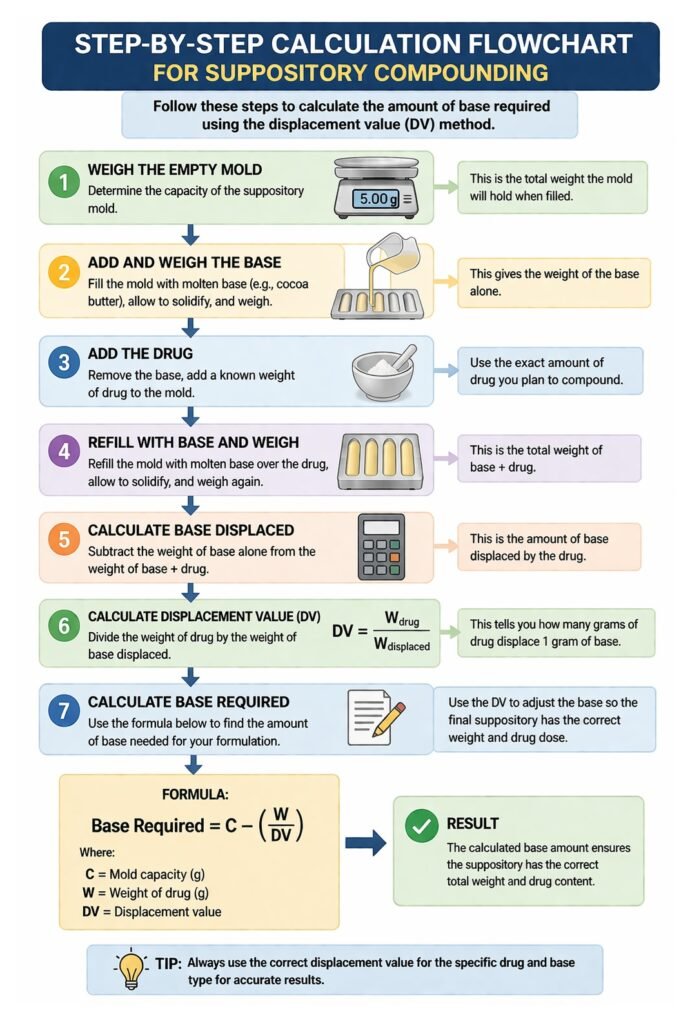
Let me walk you through this like we’re making suppositories together. You’ll need four things:
- total mold capacity,
- drug weight,
- displacement factor, and
- base required.
Step 1: Know Your Mold Capacity
First, figure out how much your empty mold holds. This is usually written on the mold itself or you can weigh a blank suppository made of just base. Let’s say your mold holds 2 grams. That’s your starting point.
Step 2: Know Your Drug Weight Per Suppository
Next, decide how much medicine goes into each suppository. A provider usually authorizes a prescription for the strength of active ingredient they need for the patient. For example, let’s say each suppository needs 200 mg of medicine. Convert that to grams because base is measured in grams. 200 mg is 0.2 grams.
Step 3: Find the Displacement Factor
The displacement factor (or displacement value) tells you how much space the medicine takes up compared to base. You can look this up in a reference book or ask a pharmacist. Let’s use 1.5 as an example.
Step 4: Calculate How Much Base Gets Displaced
Use this formula:
- Drug weight ÷ Displacement factor
- 0.2 grams ÷ 1.5 = 0.133 grams
That 0.133 grams is how much base the medicine pushes out of the way.
Step 5: Find Base Required for One Suppository
Now subtract the displaced base from the mold capacity:
- Mold capacity – Displaced base = Base required per suppository
- 2 grams – 0.133 grams = 1.867 grams
So each suppository needs 1.867 grams of base.
Step 6: Multiply by How Many You’re Making
If you’re making 10 suppositories, just multiply:
1.867 × 10 = 18.67 grams of base total
Suppository Calculation Formula
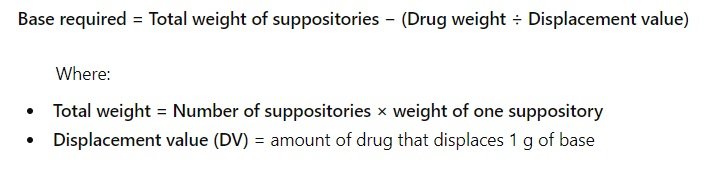
The formula Base required = Total mold capacity – (Drug weight ÷ Displacement value) tells you how much base to use.
- First, divide the drug weight by the displacement value. This gives you the amount of base the medicine pushes out of the way.
- Then, subtract that number from the total mold capacity. What’s left is exactly how much base you need for one suppository.
Common Suppository Displacement Values Table
Displacement values vary depending on the medicine. They aren’t random, infact they’re based on the density of the active ingredient.
| Name of Ingredient | DV (Displacement Value) |
|---|---|
| Aminophylline | 1.1 – 1.3 |
| Aspirin (Acetylsalicylic acid) | 1.1 |
| Balsam of Peru | 0.83 – 1.0 |
| Bisacodyl | 0.65 |
| Bismuth Subgallate | 2.5 – 3.0 |
| Bismuth Subnitrate | 0.3 – 0.33 |
| Boric Acid | 0.63 – 0.67 |
| Caffeine | 0.60 – 0.74 |
| Camphor | 1.45 – 1.49 |
| Chloral Hydrate | 0.66 – 0.67 |
| Hydrocortisone Acetate | 0.73 – 1.5 |
| Ichthammol | 0.91 |
| Lidocaine (base) | 1.0 |
| Menthol | 1.48 |
| Morphine Hydrochloride | 0.65 – 0.83 |
| Paracetamol (Acetaminophen) | 0.65 – 1.5 |
| Phenobarbital | 0.81 – 0.82 |
| Zinc Oxide | 0.15 – 4.8 |
Types of Suppository Bases
Suppository bases are the waxy or solid materials that hold the medicine. Different bases work for different needs. Here are the most common ones.
Cocoa Butter
Cocoa butter is a classic base. It melts at body temperature, so it softens quickly inside the body. It’s natural and easy to work with. But it can melt in your hands on a hot day, so you have to store it in the fridge.
Cocoa butter suppository calculation works the same way as any other base. You still use the displacement formula to figure out how much cocoa butter to mix with your medicine.
PEG Bases
PEG stands for polyethylene glycol. These are water-soluble bases that don’t melt — they slowly dissolve in body fluids. They’re great for medicines that don’t work well in fatty bases like cocoa butter. PEG bases come in different hardness levels, so you can pick one that fits your needs.
Glycerinated Gelatin
This base is made from gelatin and glycerin. It’s also water-soluble and stays firm at room temperature. It’s often used for vaginal suppositories because it releases medicine slowly. The downside is that it can dry out and get hard if not stored properly.
Other Bases
Witepsol
Witepsol is a man-made fat that acts a lot like cocoa butter but is more stable.
Fatty acid oils –
Fatty acid oils is sometimes used for special formulas.
No matter which base you pick, the displacement formula stays the same. Just swap out the base type and do the math.
Common Errors in Suppository Calculations
Even small mistakes can ruin a batch of suppositories. Here are two big ones to watch out for.
Ignoring Displacement Value
- This is the most common error. Many people think they can just fill the mold with base and add the medicine on top. That doesn’t work.
- When you ignore the displacement value, you end up with suppositories that are either too big or too small. If you add medicine without subtracting base, the total weight goes over the mold capacity. Your suppositories will bulge out or crack.
- On the flip side, if you use less base but don’t calculate it right, the suppository might be too weak. Always run the numbers. A few seconds of math saves you from wasting ingredients.
Wrong Density Assumption
Every medicine has its own density. Some are heavy and dense. Others are light and fluffy.
If you assume all medicines have the same density, your calculations will be off. For example, zinc oxide is dense. If you treat it like a fluffy medicine, you’ll add way too much base. Your suppositories will be too small because the medicine takes up less space than you thought.
Always look up the displacement value for your specific medicine. Don’t guess. When in doubt, check a reference book. Guessing leads to failed batches.
Suppositories Calculations Question 1
If my mold holds 2.5 grams, I’m making 12 suppositories, each with 200 mg of active ingredient, and the displacement value is 1.4, how much base do I need?Step by step Explanation:
Let me walk you through it step by step.
- First, convert the medicine from milligrams to grams. 200 mg is 0.2 grams per suppository.
- Next, figure out how much base is replaced by active ingredient. You do this by dividing the active ingredient weight by the displacement value: 0.2 ÷ 1.4 = about 0.143 grams displaced per suppository.
- Now, take the mold capacity and subtract that displaced amount: 2.5 – 0.143 = about 2.357 grams of base needed for one suppository.
- Finally, multiply by how many suppositories you’re making: 2.357 × 12 = about 27.28 grams of base total.
Answer:
You will need about 27.14 grams of base.Suppositories Calculations Question 2
Why does my suppository look too small even though I used the right mold and added all the correct ingredient?
Explanation:
When you add active ingredient to a supp, it takes up space in the mold. If you just fill the rest with base like normal, the total weight stays the same, but the active ingredient has pushed some base out. The problem is, the medicine itself has a different density than the base. If you don’t adjust for that, your final supp. might end up smaller or even oversized.
In your case, the suppository looks small because you used too little base. The active ingredient took up more space than you thought, so you needed to reduce the base more. That’s why the displacement value exists. It tells you exactly how much base to subtract so the suppository fills the mold perfectly and has the right strength.
Always run the numbers before compounding. A quick calculation saves you from wasting ingredients and ending up with uneven suppositories.
Frequently Asked Questions About Suppository Calculations
1. What are suppository calculations in pharmacy?
Suppository calculations are used in pharmaceutical compounding to determine the correct amount of drug and base required, considering displacement value and mold capacity.
2. How do you calculate suppository displacement value?
The suppository displacement value is calculated by determining how much base is displaced by a specific amount of drug, helping ensure accurate formulation.
3. What is displacement value in suppository calculations?
Displacement value refers to the amount of drug that displaces 1 gram of suppository base, which is essential for accurate compounding calculations.
4. How do you calculate suppository base required?
The base required is calculated using the formula: total mold capacity minus the amount of base displaced by the drug using its displacement value.
5. What is the formula for suppository calculations?
A common formula is: Base required = Total mold capacity – (Drug weight ÷ Displacement value), used in pharmacy compounding.
6. How do you calculate cocoa butter suppositories?
Cocoa butter suppository calculations involve determining mold capacity and adjusting for displacement value to ensure proper drug distribution.
7. What is a suppository displacement factor?
The displacement factor (or displacement value) indicates how much suppository base is replaced by the drug, ensuring accurate dosage in compounding.
8. Why is displacement value important in pharmacy calculations?
Displacement value is important because it prevents underdosing or overdosing by accounting for the volume occupied by the drug in the suppository base.
9. How do pharmacy students solve suppository calculation problems?
Pharmacy students solve suppository calculations by identifying mold capacity, drug amount, and displacement value, then applying the standard formula step by step.
10. What are common errors in suppository calculations?
Common errors include ignoring displacement value, using incorrect mold capacity, and miscalculating drug-to-base ratios in compounding.
11. What types of bases are used in suppository compounding?
Common suppository bases include cocoa butter (fatty base), polyethylene glycol (PEG), and glycerinated gelatin, each requiring different calculations.
12. Can I use a suppository calculator for pharmacy exams?
Yes, a suppository calculations calculator helps pharmacy students practice displacement value problems and prepare for exams like the PTCB or NAPLEX.
References
-
University of North Carolina – Suppository Compounding Lab
Covers suppository displacement value, compounding methods, and calculation examples.
-
University of Washington – Pharmaceutical Calculations Course Material
Provides foundational pharmaceutical calculation formulas and problem-solving methods.
-
PharmD Academic Curriculum – Suppositories Section
Highlights suppository bases, displacement value, and compounding techniques in pharmacy education.
-
Pharmaceutical Research Study – Suppository Bases and Formulation
Discusses types of suppository bases and their role in drug release and formulation design.
Medical Review & Calculator Development
This calculator and its related educational content have been verified by Adesh Pundir, RPh, a licensed pharmacist in the State of Texas (License #54111) with professional pharmacy experience since 2013. Adesh also holds a Master’s Degree in Information Systems, combining healthcare expertise with advanced knowledge of technology, software development, and healthcare information systems.
His areas of expertise include pharmacy calculations, medication dosing algorithms, pharmaceutical compounding, pharmacy informatics, counseling, healthcare software solutions, and clinical decision-support systems. Each calculator is designed using established pharmacy principles, professional standards, USP guidelines where applicable, and evidence-based references to help improve calculation accuracy, educational value, and patient safety.
Disclaimer: This content is for educational purposes only and should not be considered medical advice. Always consult a qualified healthcare professional for personalized recommendations.