
Nystatin Suppository Compounding Calculator – IU to mg & Base Amount
Nystatin Suppository Compounding
Required Quantities
Displacement value · step by step
Potency used to convert IU → mg.
Nystatin Suppository Formula Calculator
A Nystatin suppository formula calculator is a helpful tool for pharmacists, pharmacy technicians, and compounding students who need to prepare customized nystatin suppositories accurately. Nystatin is an antifungal medication commonly used to treat fungal infections caused by Candida species. When a commercially available product does not meet a patient’s needs, a compounded suppository may be prepared using a specific formula and dosage.
Using a calculator helps reduce calculation errors and ensures that the correct amount of active ingredient and suppository base are included in every batch. Whether you are preparing a small quantity or a larger batch, accurate calculations are essential for patient safety and product quality.
Why Use a Nystatin Suppository Calculator?
A compounding calculator can help you:
- Determine the total amount of nystatin needed
- Calculate nystatin units for each suppository
- Estimate the amount of suppository base required
- Scale formulas for different batch sizes
- Improve compounding accuracy
- Save time during prescription preparation
Understanding Nystatin Suppository Compounding
Nystatin suppository compounding involves combining nystatin powder with an appropriate suppository base to create a customized medication. Compounding is often performed when a patient requires a specific strength, dosage form, or treatment plan that is not commercially available.
Important Considerations During Compounding
Before preparing a batch, pharmacists should consider:
- Prescribed strength per suppository
- Number of suppositories required
- Type of suppository base
- Displacement factors if applicable
- Stability and storage requirements
- Beyond-use date recommendations
Nystatin Units Calculation for Compounding
When you compound nystatin suppositories, the medicine is measured in International Units (IU), not milligrams. That’s because nystatin is a potent antibiotic and its strength is based on its activity, not its weight. But when you mix it into a base, you need to know how many milligrams of powder to weigh out. That’s where the potency number comes in.
Every batch of nystatin has a potency listed on the container, like 4,400 IU per mg. That means each milligram of powder contains 4,400 units of active medicine. To figure out how much powder to use, you divide the dose you need by the potency. For example, if you need 100,000 IU per suppository, you do 100,000 ÷ 4,400 = about 22.7 mg of powder per suppository.
Then you multiply by how many suppositories you’re making to get the total powder weight. Once you have that, you use the displacement value to adjust the base so the suppository fits the mold perfectly. It sounds like a lot, but once you get the hang of it, it’s just basic division and multiplication.
Real-Life Example 1
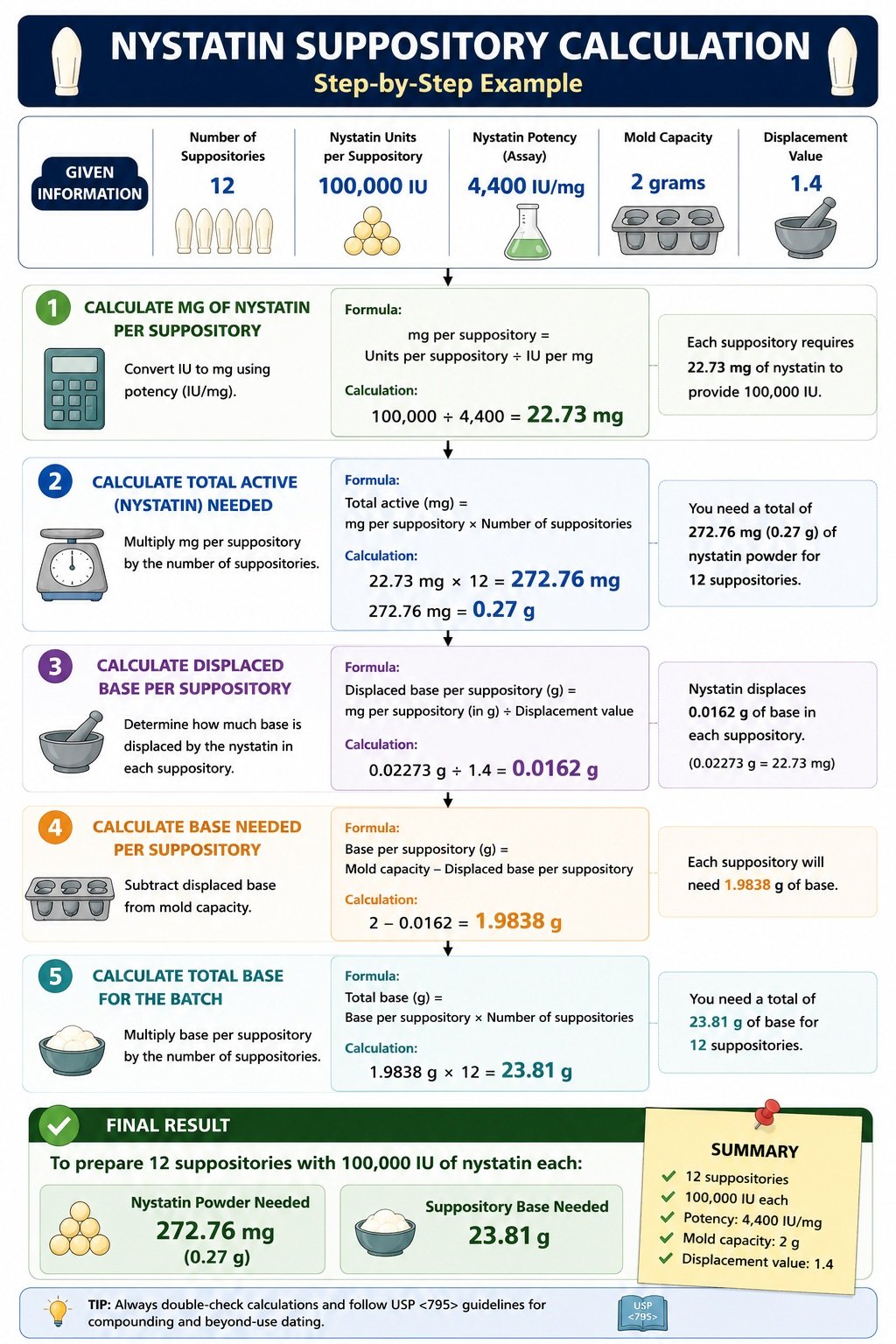
You need 12 suppositories, each with 100,000 IU of nystatin. Your potency is 4,400 IU/mg. Mold holds 2 grams, displacement value is 1.4.
Step 1: mg per suppository = 100,000 ÷ 4,400 = 22.73 mg
Step 2: Total active = 22.73 × 12 = 272.76 mg = 0.27 g
Step 3: Displaced base per suppo = 0.02273 g ÷ 1.4 = 0.0162 g
Step 4: Base per suppo = 2 – 0.0162 = 1.9838 g
Step 5: Total base = 1.9838 × 12 = 23.81 g
You need 272.76 mg (0.27 g) of nystatin powder and 23.81 g of base.
Real-Life Example 2
You need 6 suppositories, each with 200,000 IU of nystatin. Potency is 5,000 IU/mg. Mold holds 2.5 grams, displacement value is 1.5.
Step 1: mg per suppo = 200,000 ÷ 5,000 = 40 mg
Step 2: Total active = 40 × 6 = 240 mg = 0.24 g
Step 3: Displaced base per suppo = 0.04 g ÷ 1.5 = 0.0267 g
Step 4: Base per suppo = 2.5 – 0.0267 = 2.4733 g
Step 5: Total base = 2.4733 × 6 = 14.84 g
You need 240 mg (0.24 g) of nystatin powder and 14.84 g of base.
Nystatin Suppository Beyond-Use Date Explained
According to USP <795> Nonsterile Compounding guidelines, the beyond-use date (BUD) of a compounded nystatin suppository depends on the formulation and ingredients used. For nonaqueous suppositories prepared from commercially manufactured ingredients, the recommended BUD is generally up to 180 days, unless ingredient stability data indicate a shorter period.
Pharmacists should always follow current USP standards, manufacturer information, and professional judgment when assigning a beyond-use date.
Frequently Asked Questions About Nystatin Suppository Compounding
1. What is the beyond-use date (BUD) for a compounded Nystatin suppository?
According to USP <795> guidelines, a nonaqueous compounded Nystatin suppository generally has a beyond-use date of up to 180 days when prepared from commercially manufactured ingredients, unless stability information supports a shorter period.
2. How is the beyond-use date of a Nystatin suppository determined?
The beyond-use date is determined using USP <795> standards, ingredient stability data, dosage form characteristics, storage conditions, and the type of ingredients used in the compounded preparation.
3. What is a Nystatin suppository formula calculator?
A Nystatin suppository formula calculator is a pharmacy tool that helps calculate the amount of Nystatin powder and suppository base required for a compounded preparation based on potency, mold size, displacement value, and batch quantity.
4. How do you perform a Nystatin units calculation?
Nystatin units calculation involves dividing the prescribed number of units per suppository by the potency of the Nystatin powder (IU per mg) to determine the amount of Nystatin needed in milligrams for each suppository and the entire batch.
5. What is the purpose of a Nystatin suppository dosage calculator?
A Nystatin suppository dosage calculator helps pharmacists accurately determine the correct amount of active ingredient needed per suppository and for the entire batch, reducing calculation errors during compounding.
6. Why is displacement value important in Nystatin suppository compounding?
The displacement value helps determine how much suppository base is displaced by the Nystatin powder. This calculation ensures the final suppository maintains the correct weight, volume, and medication strength.
7. What information is included in a Nystatin suppository master formulation record?
A Nystatin suppository master formulation record typically includes ingredient quantities, equipment needed, preparation instructions, quality control procedures, packaging requirements, storage recommendations, and beyond-use date information.
8. What are the USP <795> requirements for Nystatin suppository preparation?
USP <795> recommends proper documentation, accurate calculations, ingredient verification, clean compounding practices, quality assurance procedures, appropriate labeling, and assignment of a suitable beyond-use date for Nystatin suppository preparation.