
Cube Volume Calculator (V = a³) – Formula, Steps & Examples
Cube Volume Formula
V = a³
The volume of a cube is calculated by multiplying the length of one side by itself three times.
- V = Volume of the cube
- a = Length of one side
Example: If the side length is 3 cm, then volume = 3 × 3 × 3 = 27 cm³
⬛ Cube volume side³
🔍 step by step
What is a cube?
A cube is basically a 3D square. Think of a die (the kind you use in board games) or a Rubik’s Cube. It has six flat faces, and every single face is a square the exact same size.
All the edges, all the lines where two faces meet, are the same length. So if you know the length of one side, you know them all. It’s one of the simplest shapes out there, which is why it’s perfect for learning how to calculate volume. It’s just length times width times height, but on a cube, they’re all the same number.
What is a cubic unit?
When you calculate the volume of a cube, the units you use really matter. Think of it like this: you’re measuring how much space is inside that cube.
If you measure the side of your cube in inches, then your volume answer will be in cubic inches. We write that as in³. If you measure in centimeters, the volume is cubic centimeters or cm³. You might also use feet (giving you ft³) or meters (giving you m³).
So basically, whatever unit you use to measure the side (like inches, feet, or cm), just cube that unit. That’s your volume unit. It tells you how many tiny little cubes (each 1 unit wide) would fit inside your big cube.
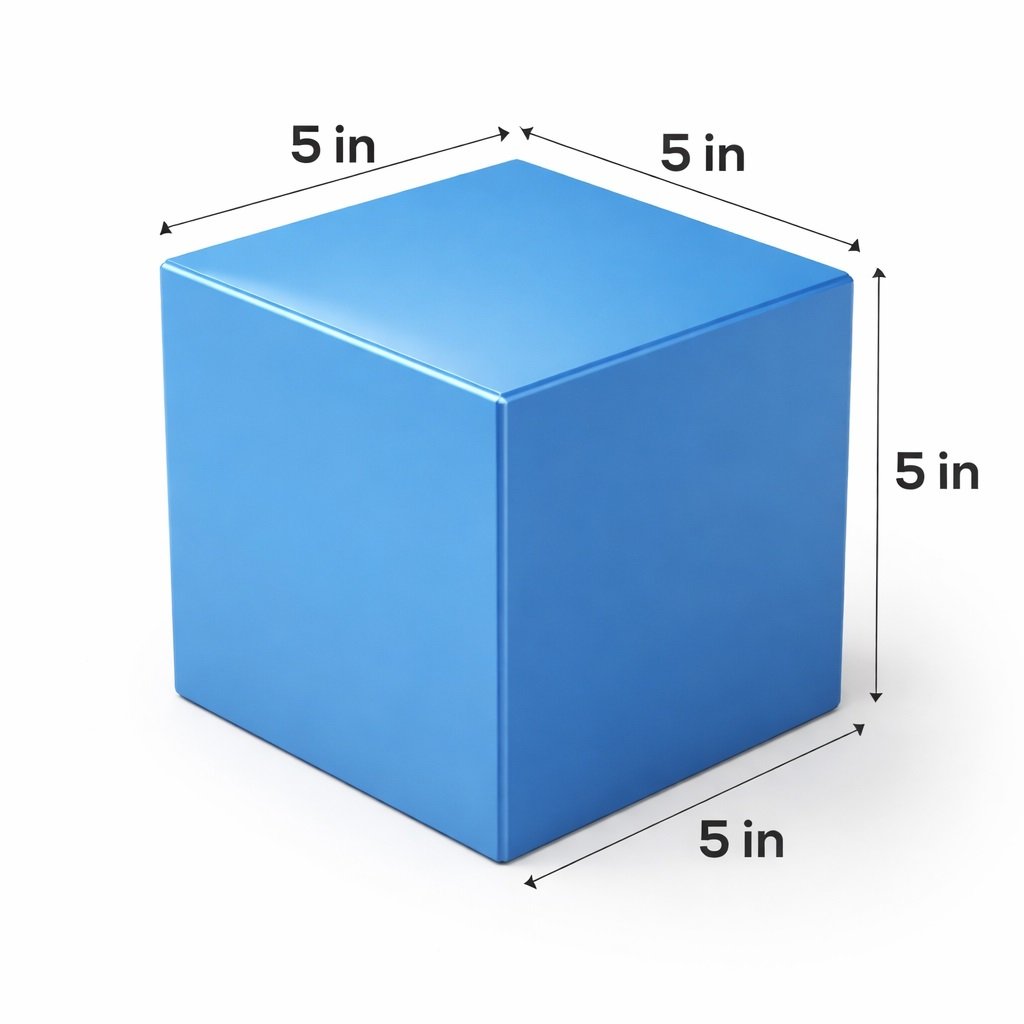
Cube Volume Calculator: Find Volume in Seconds
Have you ever looked at a square box, a dice, or even a kid’s building block and wondered, “How much stuff can actually fit inside?” That’s exactly what we’re talking about today. Whether you’re a student trying to finish homework, a DIYer planning a storage project, calculating yards of soil needed for backyard, or just someone who loves neat measurements, you’ve come to the right place.
What is the volume of a cube?
The volume of a cube is the total amount of space that is inside the cube. Think of it as the “inner capacity.” If you could make a perfect hole in a cube, the volume is how much water, sand, or air it could hold.
The sides of a cube are all the same dimensions, which makes it a special . A cube is different from a rectangle in that all of its sides are of the same length, width, and height. So, when someone asks for the cube volume, they really mean “How many cubic units can fit inside this perfect 3D square?”
For instance, a cube with sides that are each 1 foot long has a volume of 1 cubic foot. Side length of a cube with dimensions of feet on each sides can hold 8 cubic feet of space. Easy, right?
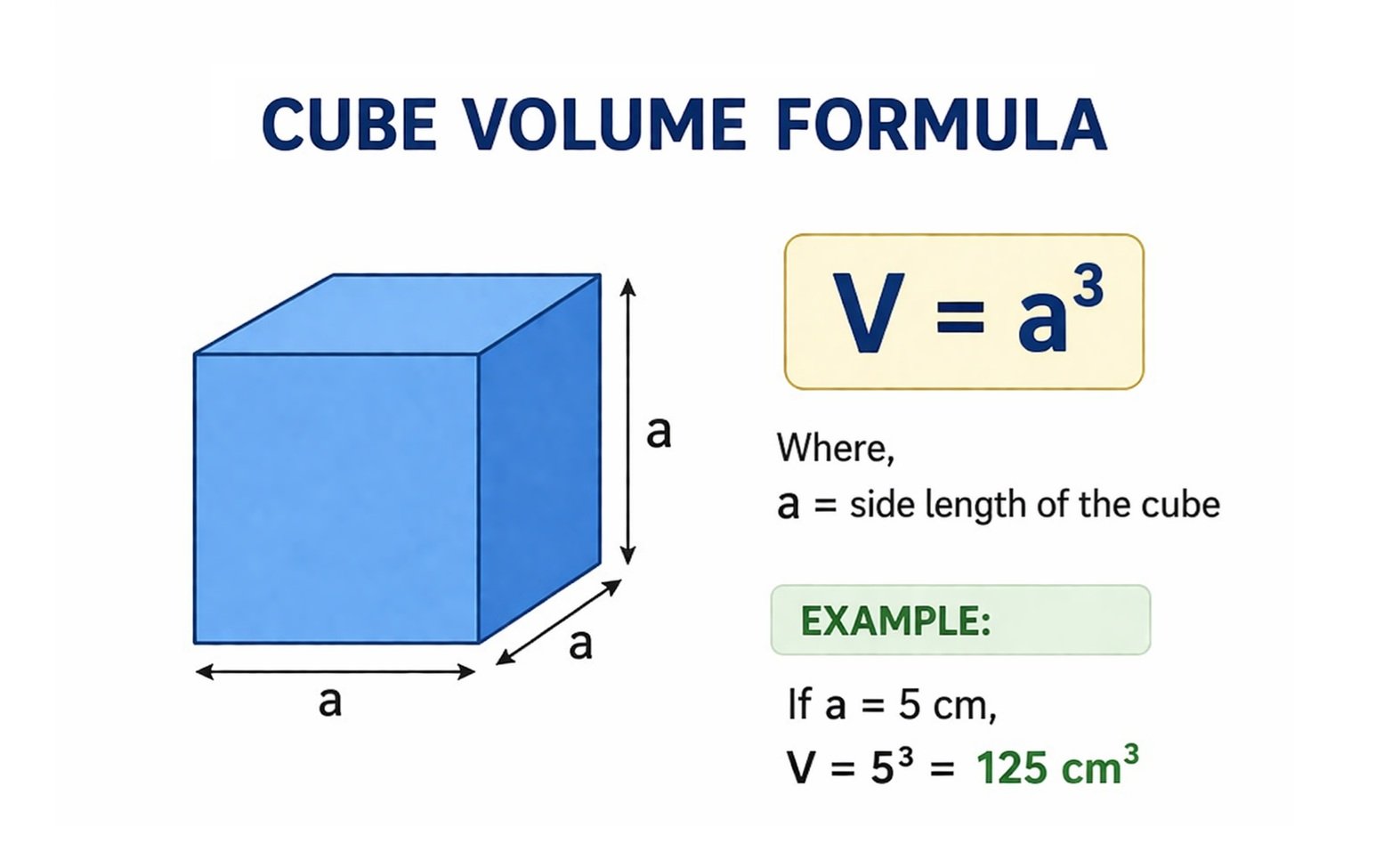
Cube Volume Formula
Okay, let’s talk about the formula without making your head spin. Every cube uses the exact same formula no matter how big or small:
Volume = side x side x side (each side)
V = a³
In normal person language, V stands for volume and s stands for the length of one side. That little 3 above the s is just a shortcut that means “multiply s by itself three times.”
So if someone writes 5³, they really mean 5 × 5 × 5 = 125 cubic units
It’s like a secret code that mathematicians use to save time. The cool thing about cubes is that this formula never changes. Whether you’re measuring in inches, centimeters, or miles, it’s always side × side × side. Once you memorize this, you’ll never forget how to find cube volume.
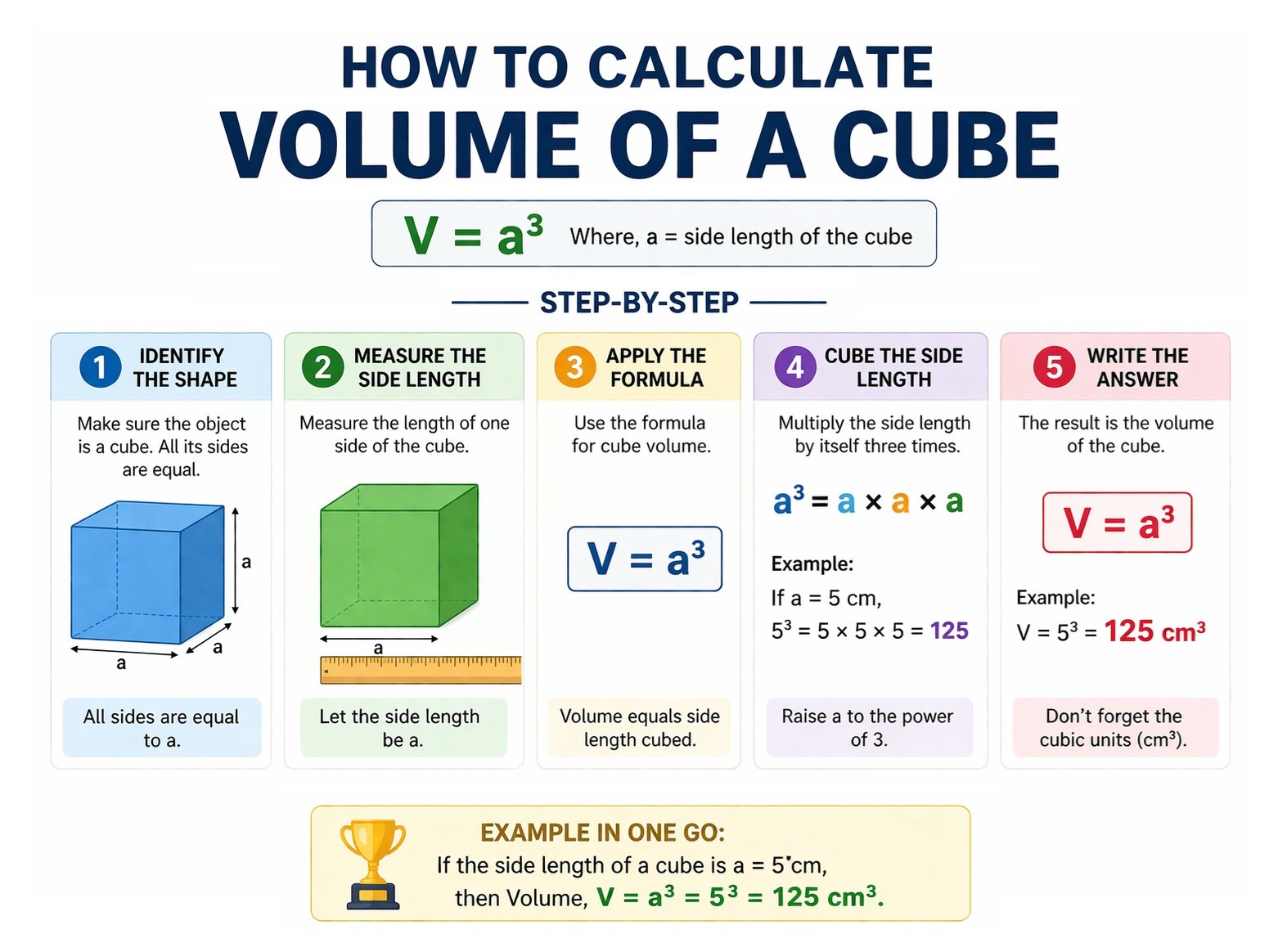
How to Calculate Volume of a Cube (Step-by-Step)
If you want to know how to calculate volume of a cube step by step, don’t worry. It’s almost too easy. Just follow these three simple steps. You can use them with any cube, big or small.
Step 1: Measure the side
First, find the side length of a cube. This is the distance from one edge to the next along one side. Dimensions could be in inches, feet, centimeters, meters or any unit that works for you, as long as you keep it consistent.
Example: Let’s say you measure a box and get side = 5 cm.
Step 2: Cube a number
Now, take that number and multiply it by itself, then by itself again. That means: side × side × side. This is the “cubing” part. You can also write it as (side)³.
For our example: 5 × 5 × 5 = 125.
That’s your raw number. You’ve just used the cube formula to find volume of cube using side length.
Step 3: Add units
This step is super important. Without units, your answer doesn’t mean much. Since you measured in centimeters, your volume will be in cubic units — specifically cubic centimeters (cm³).
So using formula for cubic volume V = a³, the final answer is: 125 cm³.
That’s it! You now know how to find cube volume in three easy steps. It works for any cube, every single time.
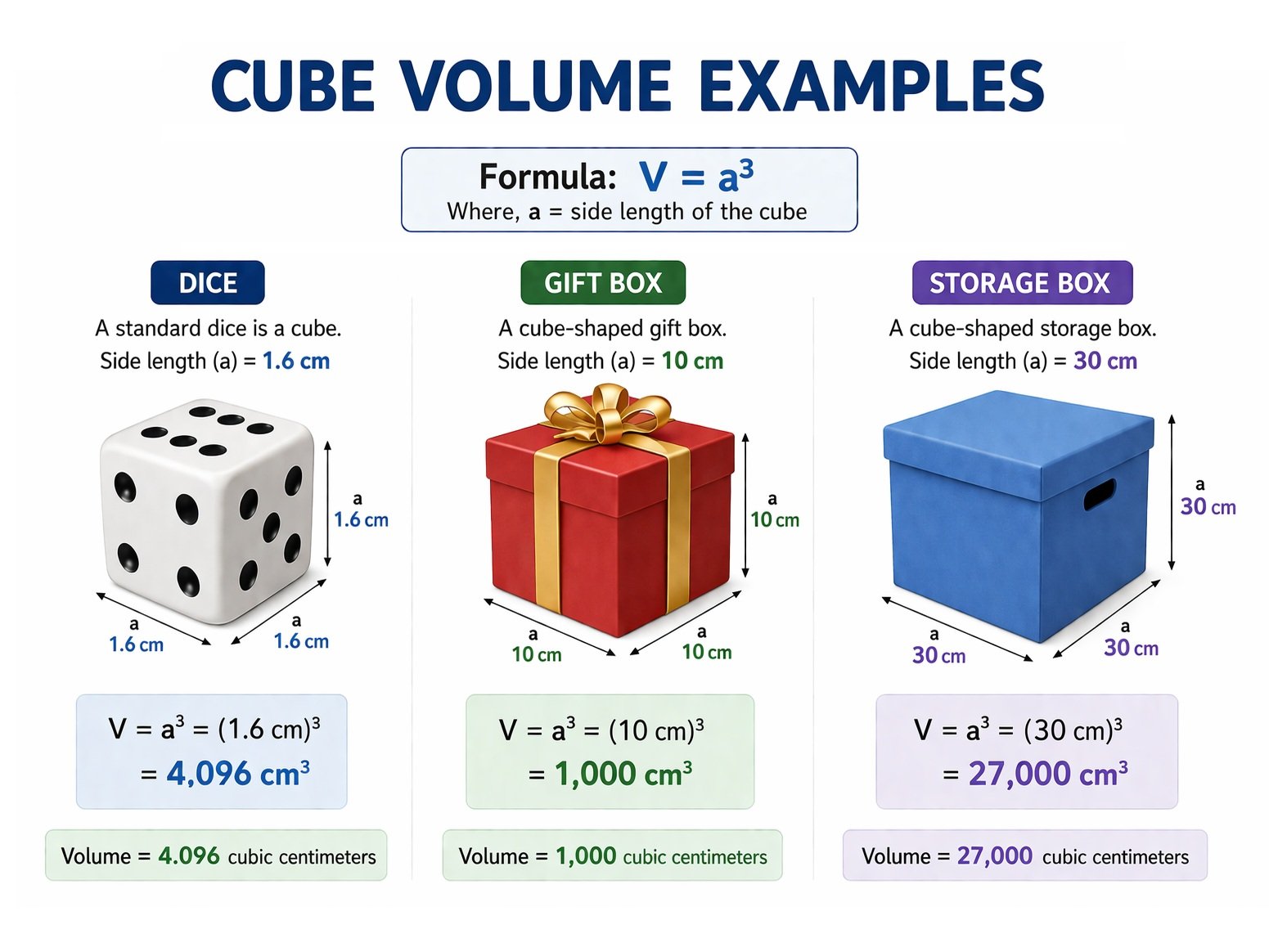
Examples of Cube Volume Calculation
Let’s discuss some real-world examples of cube volume calculation. Each of these uses the same cube volume formula but with different sizes.
Example 1: A Dice (Gaming Cube)
A standard dice we use in board games has a side of about 1.6 cm. What is its volume of a cube?
Volume = 1.6 × 1.6 × 1.6 = 4.096 cm³.
That’s roughly 4 cubic centimeters.
Example 2: A Gift Box
Let’s say we have a cute little gift box that is shaped like a perfect cube. Each side is 10 inches. How much space is inside for gift box?
Volume = 10 × 10 × 10 = 1,000 cubic inches.
That’s a nice, round number. Now you know exactly how much room you have for packing tissue paper and presents.
Example 3: A Storage Cube (Furniture)
Many modern storage units are cube-shaped, like fabric organizers or cube shelves. Suppose one cube has a side length of 15 inches.
Volume = 15 × 15 × 15 = 3,375 cubic inches.
That’s a lot of space for books, toys, or clothes. This is a perfect cube volume explained moment: the bigger the side, the faster the volume grows.
Cube Volume Chart (Side Length vs Volume)
| Side Length (a) | Volume (a³) | Example Units |
|---|---|---|
| 1 | 1 | 1 inch³ / cm³ |
| 2 | 8 | 8 inch³ / cm³ |
| 3 | 27 | 27 inch³ / cm³ |
| 4 | 64 | 64 inch³ / cm³ |
| 5 | 125 | 125 inch³ / cm³ |
| 6 | 216 | 216 inch³ / cm³ |
| 7 | 343 | 343 inch³ / cm³ |
| 8 | 512 | 512 inch³ / cm³ |
| 9 | 729 | 729 inch³ / cm³ |
| 10 | 1,000 | 1,000 inch³ / cm³ |
| 11 | 1,331 | 1,331 inch³ / cm³ |
| 12 | 1,728 | 1,728 inch³ / cm³ |
| 13 | 2,197 | 2,197 inch³ / cm³ |
| 14 | 2,744 | 2,744 inch³ / cm³ |
| 15 | 3,375 | 3,375 inch³ / cm³ |
| 16 | 4,096 | 4,096 inch³ / cm³ |
| 17 | 4,913 | 4,913 inch³ / cm³ |
| 18 | 5,832 | 5,832 inch³ / cm³ |
| 19 | 6,859 | 6,859 inch³ / cm³ |
| 20 | 8,000 | 8,000 inch³ / cm³ |
| 25 | 15,625 | 15,625 inch³ / cm³ |
| 30 | 27,000 | 27,000 inch³ / cm³ |
| 35 | 42,875 | 42,875 inch³ / cm³ |
| 40 | 64,000 | 64,000 inch³ / cm³ |
| 45 | 91,125 | 91,125 inch³ / cm³ |
| 50 | 125,000 | 125,000 inch³ / cm³ |
| 55 | 166,375 | 166,375 inch³ / cm³ |
| 60 | 216,000 | 216,000 inch³ / cm³ |
| 65 | 274,625 | 274,625 inch³ / cm³ |
| 70 | 343,000 | 343,000 inch³ / cm³ |
| 75 | 421,875 | 421,875 inch³ / cm³ |
| 80 | 512,000 | 512,000 inch³ / cm³ |
| 85 | 614,125 | 614,125 inch³ / cm³ |
| 90 | 729,000 | 729,000 inch³ / cm³ |
| 95 | 857,375 | 857,375 inch³ / cm³ |
| 100 | 1,000,000 | 1,000,000 inch³ / cm³ |
| 150 | 3,375,000 | 3,375,000 inch³ / cm³ |
| 200 | 8,000,000 | 8,000,000 inch³ / cm³ |
| 250 | 15,625,000 | 15,625,000 inch³ / cm³ |
| 300 | 27,000,000 | 27,000,000 inch³ / cm³ |
| 350 | 42,875,000 | 42,875,000 inch³ / cm³ |
| 400 | 64,000,000 | 64,000,000 inch³ / cm³ |
| 450 | 91,125,000 | 91,125,000 inch³ / cm³ |
| 500 | 125,000,000 | 125,000,000 inch³ / cm³ |
| 600 | 216,000,000 | 216,000,000 inch³ / cm³ |
| 700 | 343,000,000 | 343,000,000 inch³ / cm³ |
| 800 | 512,000,000 | 512,000,000 inch³ / cm³ |
| 900 | 729,000,000 | 729,000,000 inch³ / cm³ |
| 1000 | 1,000,000,000 | 1,000,000,000 inch³ / cm³ |
The cube volume chart above shows how the volume of a cube increases as the side length grows.
Use this table to quickly find cube volume values without calculation using the formula V = a³.
👉 Download Cube Volume Chart PDF (Free Printable)
File size: (42 KB)
Format: (PDF)
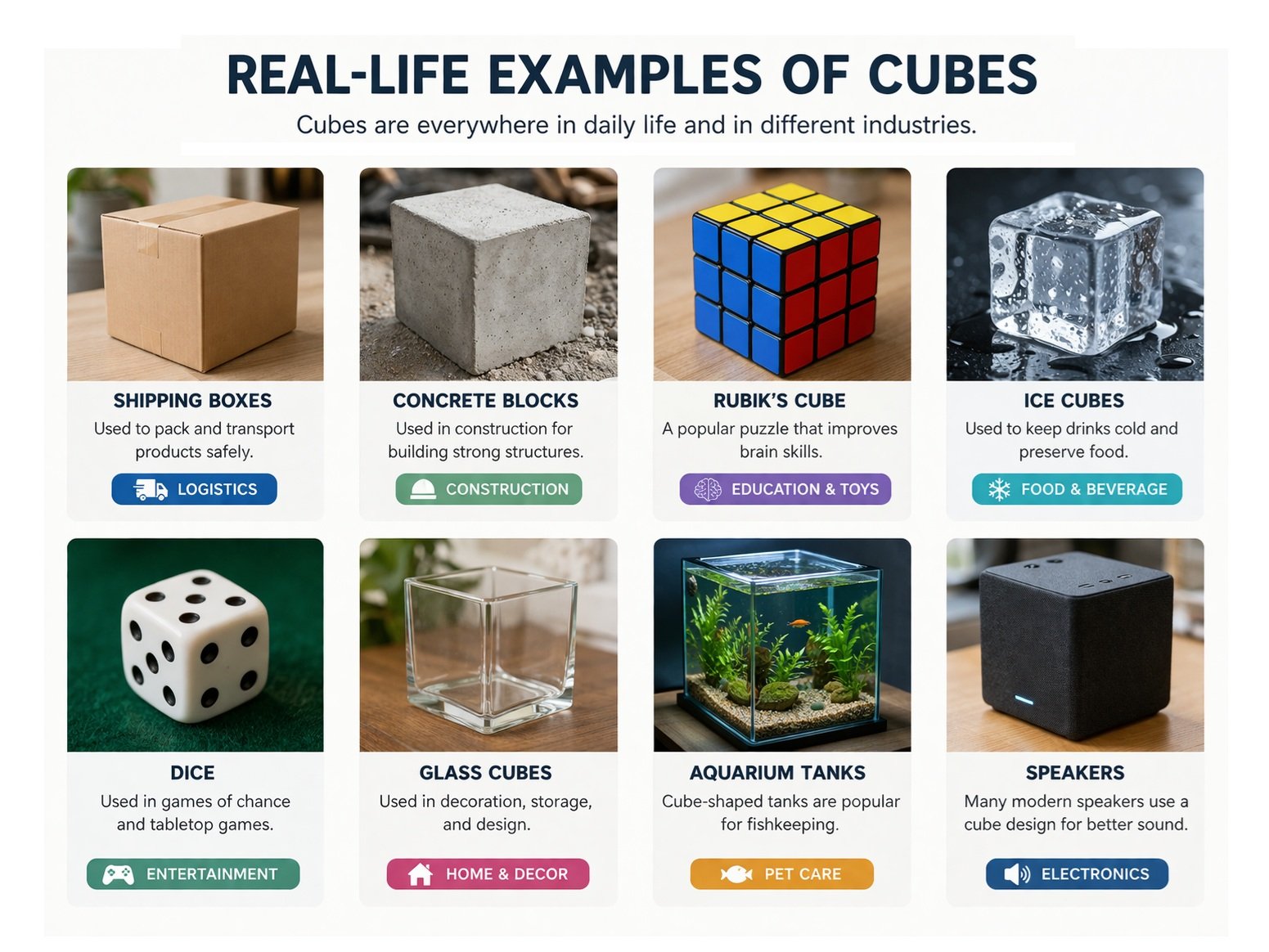
Real-Life Applications of Cube Volume
You might be thinking, “Okay, but when will I ever use this?” The truth is, cube volume is everywhere. Once you start noticing, you can’t unsee it. Here are some practical, everyday uses.
Shipping boxes
Think of Amazon boxes or any standard shipping carton. Many are not perfect cubes, but cube-shaped ones are very common for heavy or dense items. Companies need to calculate cube volume to figure out shipping costs. The more cubic space a box takes, the more it costs to send. That’s why they use the cube volume equation all day long.
Storage containers
Many storage containers are cube-shaped, like small plastic bins and big shipping containers. Knowing the volume of a cube can help you figure out how much you can store. For instance, a 3-foot cube storage bin can hold 27 cubic feet of stuff, which is the same as a whole closet.
Construction materials
Concrete blocks or foam insulation panels are mostly shaped as cubes. Builders use the cube volume formula to figure out how many blocks can comfortable fit in a truck or how much concrete is needed to fill a mold. Even when pouring a cube-shaped foundation, you need to find cube volume to order the right amount of material. This helps in building cost effective strategy.
Packaging industry
Packaging engineers love cubes because they stack perfectly without wasting space. When designing a box for a product, they use how to find cube volume to ensure the item fits perfectly. This reduces waste, saves money, and protects the product. The cube volume formula with example is part of their daily math.
Aquariums
Many small fish tanks are cube-shaped. If you have a 12-inch cube tank, its volume is 1,728 cubic inches. Convert that to gallons (about 7.5 gallons), and you know how much water and how many fish it can hold.
Moving and logistics
Professional movers always measure boxes. A cube-shaped moving box with a 2-foot side has 8 cubic feet of space. By calculating cube volume for each box, movers can plan truck loads efficiently. This saves fuel, time, and money.
Education and classroom tools
Teachers use cubes to explain 3D math models. Using wooden blocks and digital models, cube volume can be explained in class that helps students understand multiplication, geometry, and real-world measurement.
Frequently Asked Questions (Cube Volume)
What is the formula for the volume of a cube?
The volume of a cube is calculated using the formula V = a³, where "a" is the length of one side. Multiply the side length by itself three times to get the volume.
How do you calculate the volume of a cube?
Measure the side length and multiply it by itself three times (a × a × a). The result is expressed in cubic units such as cm³, m³, or in³.
What does “cubed” mean in math?
“Cubed” means raising a number to the power of 3. It is the same as multiplying a number by itself three times.
What units are used for cube volume?
Cube volume is expressed in cubic units such as cubic centimeters (cm³), cubic meters (m³), or cubic inches (in³).
Can the volume of a cube be negative?
No, the volume of a cube cannot be negative because side length is always positive. Therefore, volume is always positive.
How is cube volume different from surface area?
Cube volume measures the space inside the cube (a³), while surface area measures the total area of all faces (6a²).
What is the volume of a cube with side length 5?
If the side length is 5, the volume is 5³ = 125. So, the volume is 125 cubic units.
Why is the cube formula a³?
A cube has equal length, width, and height. Multiplying these three equal dimensions (a × a × a) results in a³.
Where is cube volume used in real life?
Cube volume is used in packaging, construction, storage calculations, and engineering to determine space and capacity.
How can I calculate cube volume quickly?
You can calculate cube volume quickly using a cube volume calculator or by referring to a cube volume chart for common values.
What are cubic units?
Cubic units measure volume in three dimensions. Examples include cm³, m³, and in³, representing length × width × height.
Is cube volume always side³?
Yes, the volume of a cube is always calculated as side³ because all three dimensions (length, width, height) are equal.
Reviewed by Adesh Pundir, Licensed Pharmacist (Texas License #54111)
This calculator is verified for accuracy and clinical relevance.
Last reviewed: April 2026
Related Volume Calculators
- Capsule Volume Calculator
- Cone Volume Calculator
- Cube Volume Calculator
- Cylinder Volume Calculator