
Triangular Prism Volume Calculator (Step-by-Step + Formula + Examples)
What Is a Triangular Prism and How Do You Find Its Volume?
A triangular prism is a 3D shape that has two triangular faces on opposite sides and three rectangular faces connecting them. It looks like a triangle stretched into a solid shape.Triangular Prism Volume Formula:
Volume = (1/2 × base × height of triangle) × length
Triangular Prism Volume Calculator | Real‑time Calculator
Instant Results
📐 Step by Step explanation
▶ Using base triangle area = ½ × side_c × height_h
⚡ Adjust any value — volume updates instantly.
Triangular Prism Volume Formula Explained
The formula for the volume of a triangular prism is:
Volume = (1/2 × base × height of triangle) × length
This can also be written as:
Volume = Area of triangle × length of the prism
First, we find the area of the triangle:
Area of triangle = 1/2 × base × height
Then, we multiply it by the length of the prism:
Volume = triangle area × length
Base (b): Bottom side of the triangle
Height (h): Vertical distance of the triangle
Length (l): Depth of the prism
Volume: Total space inside the 3D shape
Area: Space inside a 2D shape
Why Do We Multiply Triangle Area × Length?
Think of it like this:
- A triangular prism is made by stretching a triangle into a 3D shape.
- The triangle is the base (front face)
- The prism extends backward with a certain length.
So, when you multiply:
Area of triangle → gives the base surface
Length → gives the depth
Volume = base area × length
Why Triangular Formula Works (Geometric Explanation)
To really understand the formula, think about the shape of a triangular prism in 3D.
A triangular prism is created when a triangle is extended (or stretched) in a straight direction. This creates a solid shape with the same triangular face repeated along its length.
Think of It Like Stacking Layers
- Imagine you take a triangle and copy it again and again, placing each copy slightly behind the previous one.
- Each triangle has the same area
- When you stack many of them, they form a solid shape
👉 This is exactly what a triangular prism is: a stack of identical triangles
From 2D Area to 3D Volume
In geometry:
- Area measures space in 2D (flat surface)
- Volume measures space in 3D (solid object)
So when you take:
The area of a triangle (base) and extend it across a length (depth) then you are turning a flat shape into a solid.
Simple Way to Visualize It
Think of pushing a triangular shape forward:
- The triangle stays the same
- Only the length increases
And after stretching, every small slice of the prism looks like the same triangle.
How to Calculate Volume of a Triangular Prism (Step-by-Step)
Calculating the volume of a triangular prism is simple when you follow the right steps. You just need to find the area of the triangle first, then multiply it by the length of the prism.
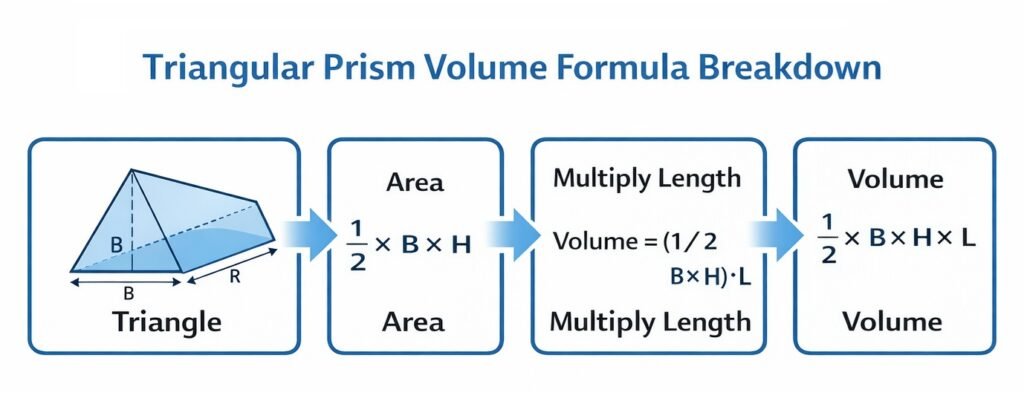
Triangular Prism Volume – Step-by-Step Flow:
Triangle → Area → Multiply Length → Volume
- Step 1: Start with the triangle (base shape)
- Step 2: Find the triangle’s area (1/2 × base × height)
- Step 3: Multiply the area by the prism length
- Step 4: Get the final volume in cubic units
👉 This simple flow makes it easy to understand how triangular prism volume is calculated.
Example 1
- Base of triangle = 6 cm
- Height of triangle = 4 cm
- Length of prism = 10 cm
Step 1: Find triangle area
- Area = 1/2 × 6 × 4 = 12 cm²
Step 2: Multiply by length
- Volume = 12 × 10 = 120 cm³
👉 Final Answer: 120 cubic centimeters
Example 2
- Base = 8 m
- Height = 5 m
- Length = 12 m
Step 1: Triangle area
- Area = 1/2 × 8 × 5 = 20 m²
Step 2: Multiply by length
- Volume = 20 × 12 = 240 m³
👉 Final Answer: 240 cubic meters
Understanding the Volume vs Length Graph of a Triangular Prism
This graph shows how the volume of a triangular prism changes as the length increases, while the base and height of the triangle remain constant.
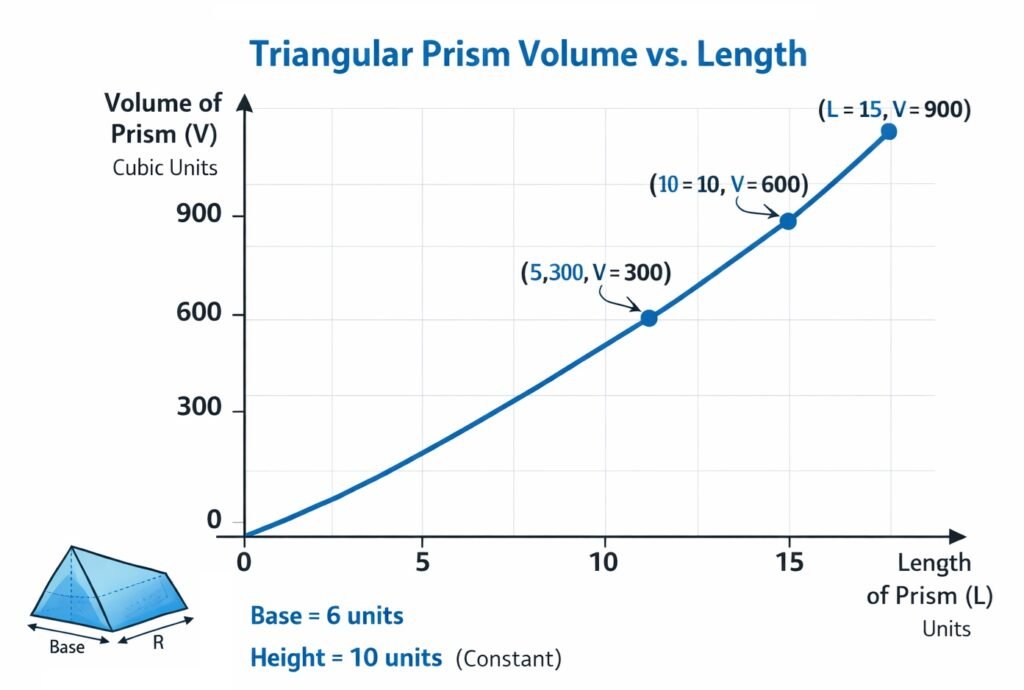
What the Graph Represents
- The X-axis (horizontal) shows the length of the prism
- The Y-axis (vertical) shows the volume of the prism
Key Observation
As the length increases, the volume also increases in a straight line.
Volume is directly proportional to the length
- If the length doubles → volume doubles
- If the length triples → volume triples
Why This Happens
- The volume formula is:
- Volume = (1/2 × base × height) × length
Since the triangle area (1/2 × base × height) is constant:
So, every increase in length adds the same amount of volume.
Example from the Graph
- At length = 5 → Volume = 300
- At length = 10 → Volume = 600
- At length = 15 → Volume = 900
👉 You can see a clear pattern:
Increasing length by 5 adds 300 units³ of volume
🔥 How Volume Changes with Length in a Triangular Prism
The volume of a triangular prism increases linearly with its length when the base and height remain constant, meaning volume is directly proportional to length.
Types of Triangular Prisms
There are mainly three types of Triangular Prisms that look slightly different from one another. This difference is based on the shape of their triangular base and how the prism is positioned. Understanding these differences helps you solve geometry problems more easily and apply the correct formulas.
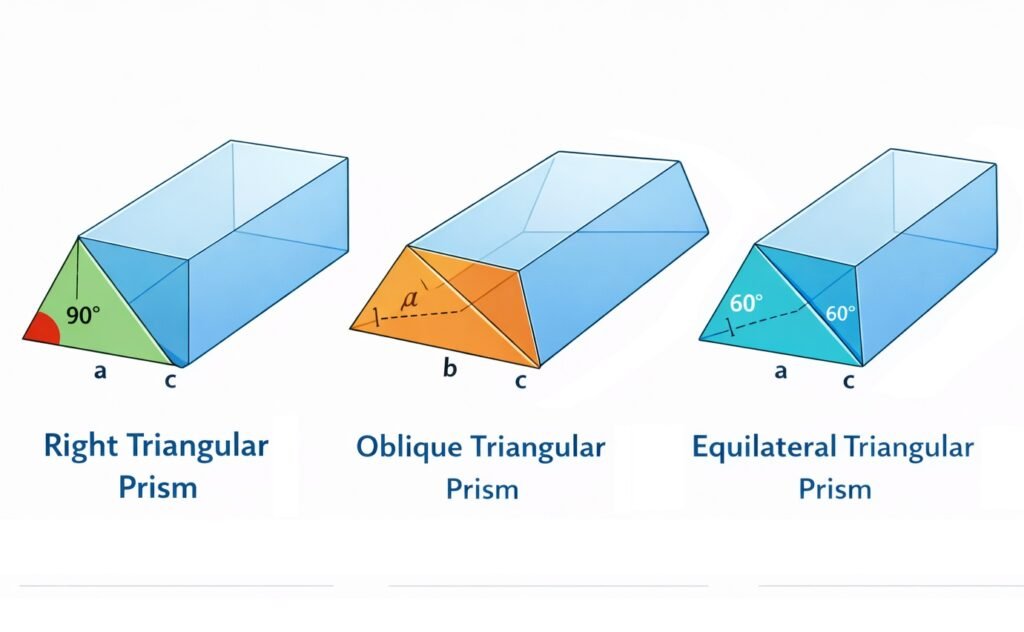
Right Triangular Prism (90 degree angle)
A right triangular prism has a triangle with a 90° angle as its base.
- One angle in the triangle is exactly 90 degrees
- The rectangular sides are perpendicular (straight up)
- This is the most common type used in basic geometry problems
Oblique Triangular Prism (slanted prisms)
An oblique triangular prism is a prism where the sides are slanted instead of straight up.
- The rectangular faces are not perpendicular to the base
- The prism appears tilted or leaning
- Volume formula still works the same
👉 Used in advanced geometry and real-world structures
Equilateral Triangular Prism (all three sides are equal)
An equilateral triangular prism has a triangle where all three sides are equal.
- All angles are 60 degrees
- The base triangle is perfectly symmetrical
- Often used in design and engineering
👉 Common in symmetrical structures and design models
Triangular Prism Types Comparison Table
| Type | Triangle Shape | Side Orientation | Key Feature |
|---|---|---|---|
| Right Triangular Prism | Right triangle (90°) | Straight (perpendicular) | Easy to calculate |
| Oblique Triangular Prism | Any triangle | Slanted | Tilted shape |
| Equilateral Triangular Prism | All sides equal | Straight | Symmetrical design |
Pro Tip
Even though these prisms look different, the volume formula remains the same for all types:
👉 Volume = Base Area × Length
Heron’s formula – Solve from 3 triangle sides
What is Heron’s Formula?
Heron’s Formula is a simple way to find the area of a triangle when you know all three sides, without needing the height.
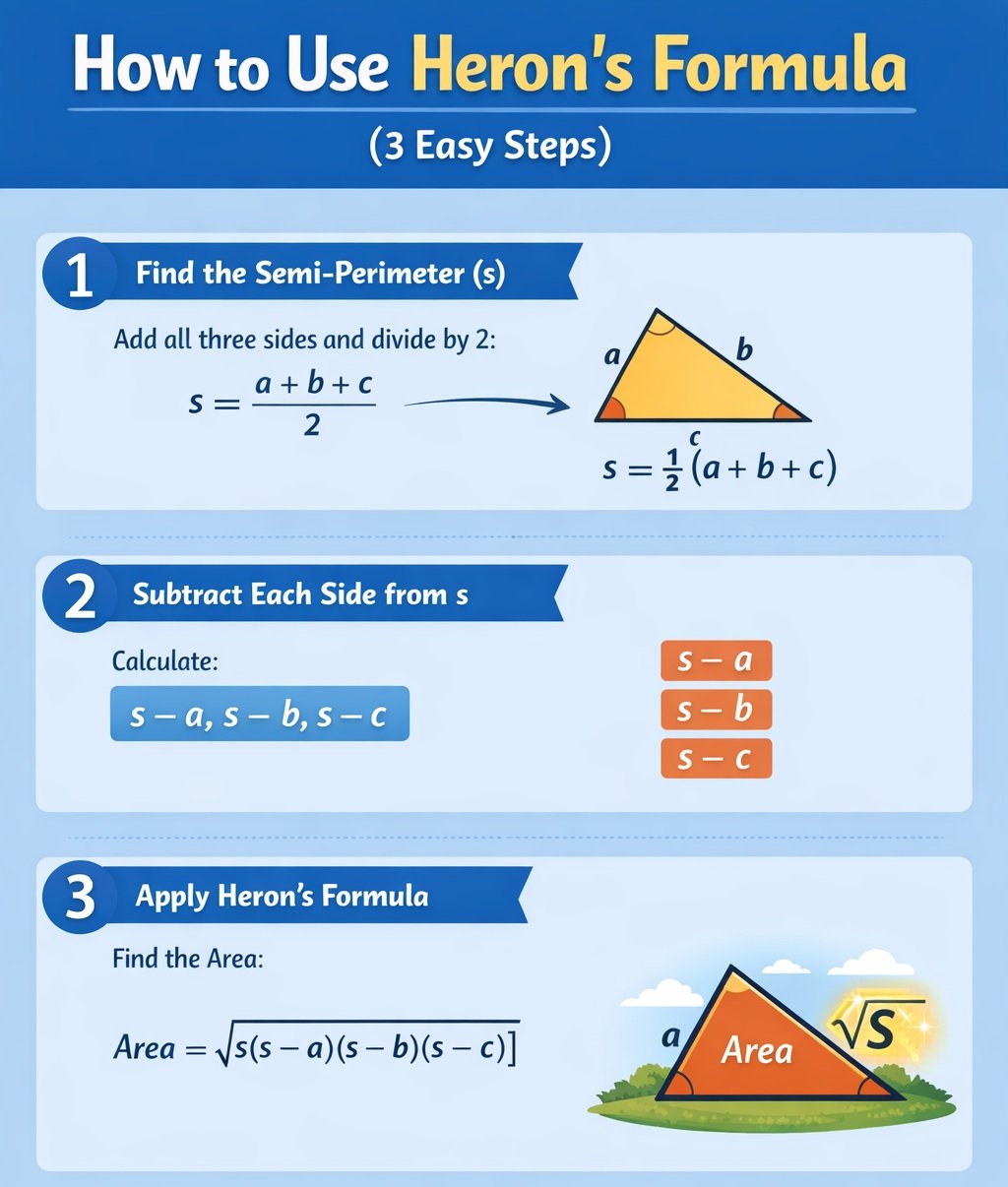
How to Use Heron’s Formula (3 Easy Steps)
-
Find the Semi-Perimeter (s):
Add all three sides of the triangle and divide by 2.
s = (a + b + c) / 2 -
Subtract Each Side from s:
Calculate (s − a), (s − b), and (s − c). -
Apply Heron’s Formula:
Use the formula to find the area:
Area = √[s(s − a)(s − b)(s − c)]
Heron’s Formula Example
Suppose a triangle has sides:
- a = 5
- b = 6
- c = 7
Step 1: Find the Semi-Perimeter (s)
s = (a + b + c) / 2 = (5 + 6 + 7) / 2 = 9
Step 2: Subtract Each Side from s
s − a = 9 − 5 = 4
s − b = 9 − 6 = 3
s − c = 9 − 7 = 2
Step 3: Apply Heron’s Formula
Area = √[s(s − a)(s − b)(s − c)]
Area = √[9 × 4 × 3 × 2]
Area = √216 ≈ 14.7
Final Answer: Area ≈ 14.7 square units
Real-Life Applications
Where Is Triangular Prism Volume Used?
Understanding the volume of a triangular prism is not just for math class—it is used in many real-life situations. From construction to packaging, this concept helps measure how much space an object can hold.
1. Roof Structures (Construction Use)
In construction, many houses have triangular-shaped roofs. These roofs often form a triangular prism shape.
Builders use the triangular prism volume formula to calculate how much space is inside the roof
Helps in estimating insulation, air space, and materials needed
Important for designing energy-efficient homes
2. Tents and Camping Structures
A Tent has front and back sides as triangles. The tent extends backward, forming a prism shape.
Using the triangular prism volume calculator helps in determining how many people or items can fit inside.
3. Packaging and Product Design
Triangular prism shapes are used for packaging items like chocolates, gifts, or specialty products designers calculate volume to:
- Maximize storage space
- Reduce material waste
- Improve product presentation
4. Engineering and Architecture
Engineers often design bridges, that used beams for support. This helps calculate load capacity and material volume.
5. Water Channels and Storage Systems
Some water channels, tanks, and containers are designed in triangular prism shapes. This helps calculate how much water or liquid can be stored
Used in irrigation and drainage systems
6. 3D Modeling and Computer Graphics
Triangular prisms are used in 3D modeling and simulations oof various designs and structures across the world. Volume calculations help in rendering realistic objects.
7. Education and Problem Solving
Students often use triangular prism volume in:
- Geometry problems
- Exams and competitive tests
- Real-world math applications

Triangular Prism Volume Unit Conversion Table (Most Important for Triangular Prism)
Using the correct volume units is essential for calculating the volume of a triangular prism. Below is a comprehensive, list of volume conversions including standard, advanced, and real-life units.
Common Volume Units
| Unit | Equivalent | Use Case |
| 1 cubic meter (m³) | 1000 liters (L) | Large structures, tanks |
| 1 cubic centimeter (cm³) | 1 milliliter (mL) | Small objects, labs |
| 1 cubic millimeter (mm³) | 0.001 cm³ | Precision measurements |
| 1 cubic foot (ft³) | 28.316 liters | Construction (US) |
| 1 cubic inch (in³) | 16.387 cm³ | Small volume calculations |
Liquid Volume Conversions
| Unit | Equivalent | Use Case |
| 1 liter (L) | 1000 mL | Liquids, containers |
| 1 US gallon | 3.785 liters | Water, fuel |
| 1 Imperial gallon | 4.546 liters | UK measurements |
| 1 quart (US) | 0.946 L | Cooking, storage |
| 1 pint (US) | 0.473 L | Food, beverages |
Large Volume Units
| Unit | Equivalent | Use Case |
| 1 cubic kilometer (km³) | 1 trillion m³ | Geography, water bodies |
| 1 acre-foot | 1233.5 m³ | Irrigation systems |
| 1 cubic yard (yd³) | 0.7646 m³ | Construction |
Scientific & Technical Units
| Unit | Equivalent | Use Case |
| 1 microliter (µL) | 0.001 mL | Lab measurements |
| 1 nanoliter (nL) | 0.000001 mL | Advanced science |
| 1 barrel (oil) | 159 liters | Petroleum industry |
Other Common Conversion Units Table
| Category | Unit | Equivalent | Best Use Case |
| Volume | 1 m³ | 1000 L | Large structures, tanks |
| Volume | 1 cm³ | 1 mL | Small measurements |
| Volume | 1 ft³ | 28.316 L | Construction (US) |
| Volume | 1 in³ | 16.387 cm³ | Small objects |
| Volume | 1 m³ | 264.17 gallons | Water storage |
| Length | 1 m | 100 cm | General measurement |
| Length | 1 cm | 10 mm | Precision work |
| Length | 1 ft | 12 in | US construction |
| Length | 1 in | 2.54 cm | Everyday use |
| Area | 1 m² | 10,000 cm² | Large surfaces |
| Area | 1 ft² | 144 in² | Floor plans |
| Liquid Volume | 1 L | 1000 mL | Liquids |
| Liquid Volume | 1 gallon (US) | 3.785 L | Fuel, water |
| Mixed Units | cm + m + ft | Convert to one unit | Before calculation |
❓ Triangular Prism Volume Frequently Asked Questions
1. What is the formula for triangular prism volume?
The formula is: Volume = (1/2 × base × height) × length. It is calculated by finding the area of the triangle and multiplying it by the prism’s length.
2. How do you calculate volume step by step?
First, calculate the triangle’s area using (1/2 × base × height). Then multiply that area by the length of the prism to get the volume.
3. What is a triangular prism in geometry?
A triangular prism is a 3D shape with two triangular bases and three rectangular faces connecting them.
4. How do you find the base area of a triangle?
Use the formula: Area = 1/2 × base × height, where height is the perpendicular distance.
5. Can volume be negative?
No, volume cannot be negative because it represents physical space, which is always positive.
6. What units are used for volume?
Volume is measured in cubic units such as cm³, m³, ft³, and liters.
7. What is the difference between prism and pyramid?
A prism has two identical parallel bases, while a pyramid has one base and all sides meet at a single point.
8. How is triangular prism used in real life?
It is used in roof structures, tents, packaging design, and engineering calculations to measure space.
9. What if triangle sides are given instead of height?
You can use Heron’s formula to find the triangle’s area using all three sides, then multiply by the prism length.
10. Is this calculator accurate?
Yes, this calculator provides accurate results when correct input values and units are used.
📚 References & Sources
The information on this page is based on trusted educational sources to ensure accuracy and reliability.
-
Khan Academy – Volume of Triangular Prism
https://www.khanacademy.org/math/geometry/hs-geo-solids/hs-geo-solids-intro/v/solid-geometry-volume -
Math Is Fun – Prisms and Volume
https://www.mathsisfun.com/geometry/prisms.html -
Studycom - How to Find the Volume of a Triangular Prism
https://study.com/skill/learn/how-to-find-the-volume-of-a-triangular-prism-explanation.html -
Cuemath - Volume of Triangular Prism
https://www.cuemath.com/measurement/volume-of-a-triangular-prism/
Other Volume Calculators
- Pyramid Volume Calculator (Cone)
- Rectangular Prism Volume Calculator
- Sphere Volume Calculator
- Tank Volume Calculator
- Triangular prism Volume Calculator