
Tank Volume Calculator—Calculate Vertical and Horizontal Tank Volume
📏 Tank Volume Calculator
📐 Tank Reference
📋 Volume Results
Enter values and press calculate
What is a Tank Volume Calculator?
A tank volume calculator is simply a tool that tells you how much liquid your tank can hold. You punch in numbers like diameter and height, and it does the math for you. No brain strain required.
So why is it important?
Imagine filling up a water tank volume calculator helps you avoid overfilling or under-ordering water. If you run a farm or have a pool at home, knowing exact cylindrical tank volume saves you from wasting money or water.
Who actually uses these?
Lots of folks use water tank volume calculator
- Engineers designing fuel or chemical storage need precise chemical tank volume calculation to meet safety rules.
- Pool owners use it to know how much chlorine or water treatment to add.
- Farmers rely on it for irrigation and livestock water tanks.
- Factory workers storing oils or chemicals use tank volume calculator to track inventory.
- Even truck drivers who haul liquids need to calculate tank capacity before loading. Getting it wrong could mean a spill or an overweight vehicle.
Bottom line: whether you’re storing drinking water, diesel, or pool chemicals, knowing your tank’s true capacity keeps things safe, saves money, and avoids messes.
How to use our Tank Volume Calculator (It’s Super Easy)
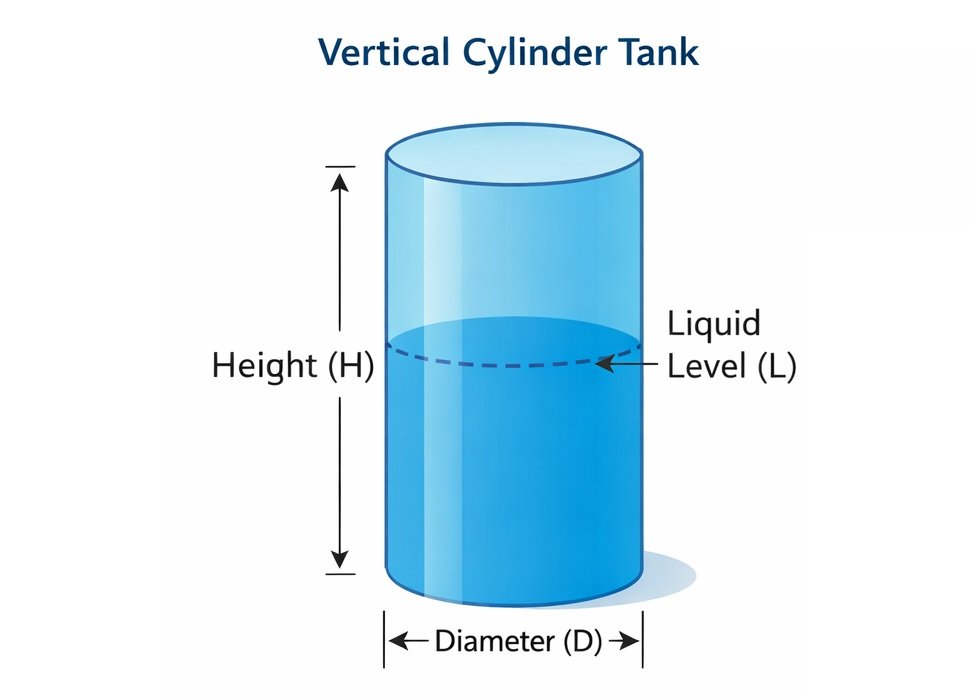
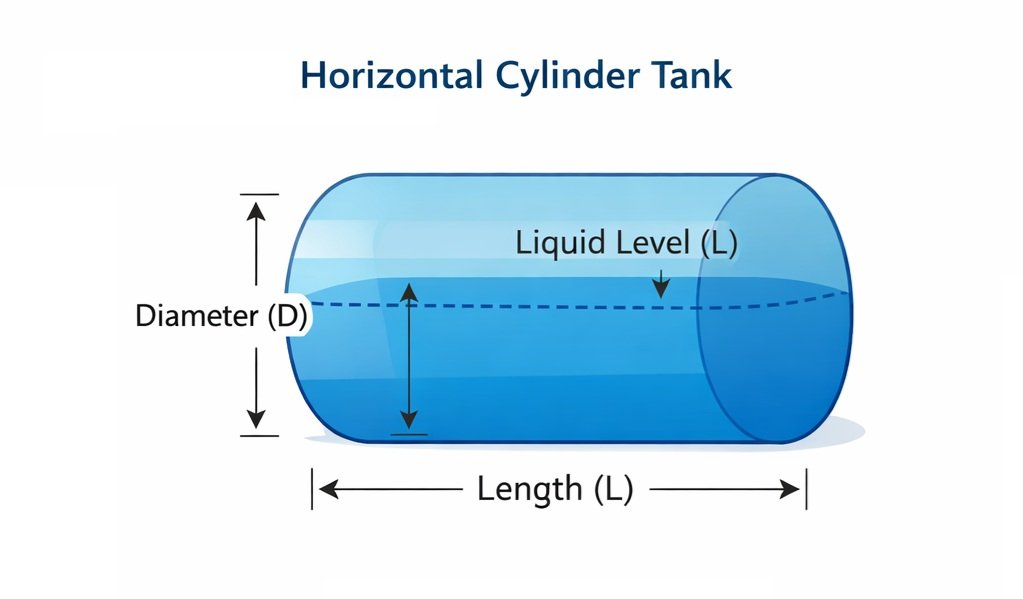
- First, pick your tank type from the drop-down menu: vertical cylinder (stands up) or horizontal cylinder (lies down). The little picture above helps you see which measurement is which.
- Next, type in the main numbers. For a vertical tank, enter the Height and Diameter. For a horizontal tank, enter the Length and Diameter. You can use decimals like 2.5 or commas like 1,5 – both work just fine.
- Now, decide if you want to measure the liquid inside. Check the “Use liquid level” box and type how high the liquid is from the bottom. If you leave it unchecked, it’ll just show the total tank capacity. This is an optional field to check.
- Hit the blue “Calculate volume” button. Boom, on the right side, you’ll see the total tank volume, how much liquid is in there, and the fill percentage.
- Scroll down a bit and you’ll find a step-by-step section showing exactly how we did the math.
Tank Volume Formula (with examples)
Figuring out how much liquid your tank can hold isn’t rocket science. Let me break it down simply.
For Vertical Cylindrical Tanks (think of a silo or upright drum)
- The formula is: Volume = π × r² × Height
- Here, “r” is the radius (half of the diameter). π is roughly 3.1416.
Example: You have a vertical tank with diameter 2 meters (so radius = 1 meter) and height 3 meters.
Volume = 3.14 × (1 × 1) × 3 = 9.42 cubic meters. That’s about 9,420 liters.
For Horizontal Cylindrical Tanks (think of a propane tank lying on its side)
- The total volume formula is same: Volume = π × r² × Length
Example: Diameter 2 meters (radius 1m), length 4 meters.
Volume = 3.14 × 1 × 4 = 12.56 cubic meters.
But here’s the tricky part – if the tank is only partly filled, you need a different formula.
For a horizontal tank with liquid height “h”, then filled volume = Length × (r² × cos⁻¹((r-h)/r) – (r-h) × √(2rh – h²))
Yeah, it looks scary, but calculators handle it.
Tank Volume Conversion Table – Gallons, Liters, Cubic Feet
| Cubic Feet (ft³) | Gallons (US) | Liters |
|---|---|---|
| 1 | 7.48 | 28.3 |
| 2 | 14.96 | 56.6 |
| 5 | 37.4 | 141.6 |
| 10 | 74.8 | 283.2 |
| 15 | 112.2 | 424.8 |
| 20 | 149.6 | 566.4 |
| 25 | 187.0 | 708 |
| 30 | 224.4 | 849.6 |
| 40 | 299.2 | 1132.8 |
| 50 | 374.0 | 1416 |
| 64 | 478.7 | 1813.1 |
| 80 | 598.4 | 2265.3 |
| 100 | 748.0 | 2832 |
| 128 | 957.5 | 3626.5 |
1. How to calculate tank volume in cubic feet?
First, measure everything in feet.
For a cylindrical tank: Volume = π × r² × height
- r = radius (half of the diameter) in feet
- π = about 3.14
Example:
- Diameter = 2 ft (so r = 1 ft), height = 3 ft
- Volume = 3.14 × (1 × 1) × 3 = 9.42 cubic feet
That’s it. Cubic feet is just length × width × height for boxes, or this formula for cylinders.
2. How to calculate tank volume in gallons ?
First find cubic feet (using above method). Then multiply by 7.48 because one cubic foot holds 7.48 gallons.
- Example: Same tank from above = 9.42 cubic feet
- Gallons = 9.42 × 7.48 = 70.5 gallons
That’s all. Cubic feet × 7.48 = gallons.
3. How to calculate tank volume in liters?
Two ways:
If you have cubic feet:
- Multiply by 28.32
- 9.42 cubic feet × 28.32 = 267 liters
If you have meters:
- Measure in meters, then volume in cubic meters × 1000 = liters
Quick cheat sheet:
1 cubic foot = 7.48 gallons = 28.32 liters
Fluid Ounces to Cups FAQs
How do I calculate the volume of a cylindrical tank?
Multiply π by the square of the radius and then multiply by the height (V = πr²h).
How do I calculate the volume of a rectangular tank?
Multiply length by width by height (V = L × W × H).
How do I calculate the volume of a spherical tank?
Use the formula V = (4/3)πr³, where r is the radius of the sphere.
What units can I use for tank volume?
You can use cubic meters, liters, cubic feet, or gallons depending on your needs.
How many gallons are in 1 cubic foot of water?
There are approximately 7.48 gallons in 1 cubic foot of water.
Can I calculate irregular-shaped tanks?
Yes, irregular shapes can be approximated by dividing them into smaller regular shapes and adding their volumes.
How accurate is a tank volume calculator?
It is highly accurate when correct measurements are used, but real-world variations may slightly affect results.
How do I convert tank volume from liters to gallons?
Multiply liters by 0.264172 to convert to U.S. gallons.
Can I calculate partially filled tank volume?
Yes, by adjusting the height or fill level in the volume formula, you can calculate partially filled tanks.
Why is tank volume calculation important for storage?
It helps ensure proper storage capacity, prevents overfilling, and supports efficient planning and resource management.